Creatine is one of the most researched supplements in sports nutrition, but many people still aren’t sure what it actually does.
You may have heard that creatine helps build muscle, improves strength, causes water weight, or should only be used by bodybuilders. Some of those claims are partly true, while others are misleading.
In simple terms, creatine helps your muscles produce energy during short, intense activity. That can be useful for weight training, sprinting, jumping, and other forms of high-intensity exercise.
When combined with consistent resistance training, creatine may also help support improvements in strength, training performance, and muscle growth.
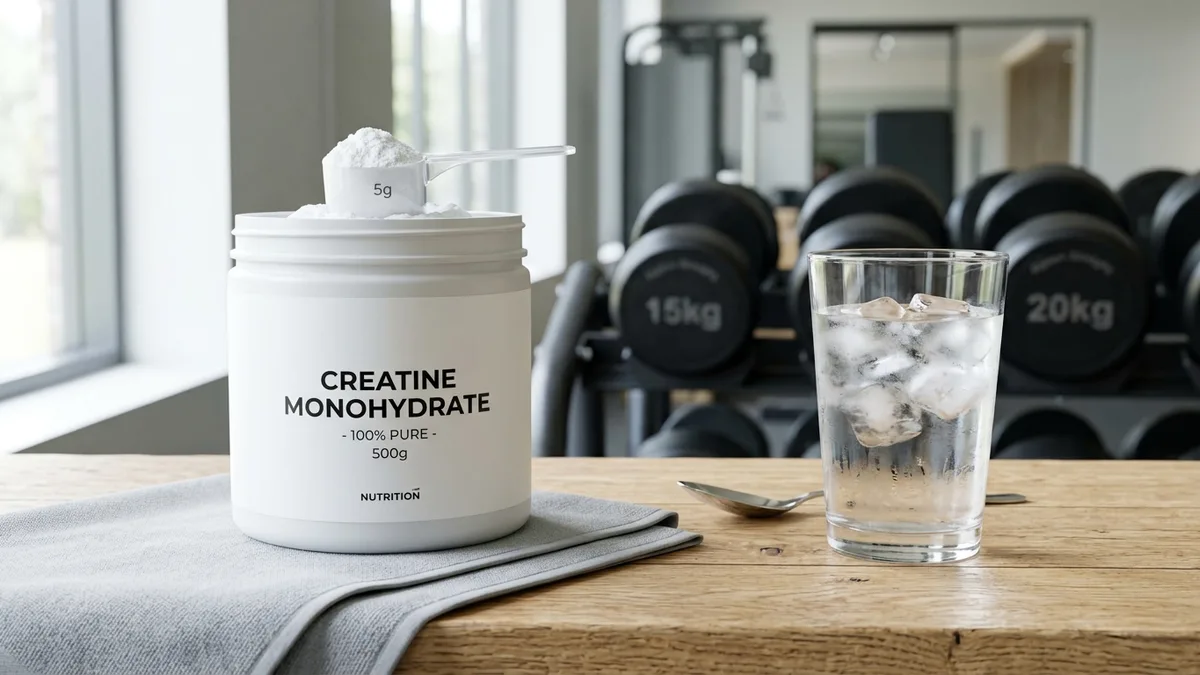
For most healthy adults who choose to use it, creatine monohydrate is the most widely studied and practical form.
A common maintenance dose is 3 to 5 grams per day.
In this guide, you’ll learn what creatine does, its main benefits, how much to take, whether you need a loading phase, when to take it, possible side effects, and what current research says about safety.
What Is Creatine?
Creatine is a naturally occurring compound that your body already produces.
Most creatine is stored in skeletal muscle, where it helps support rapid energy production during intense physical activity.
You can also get small amounts of creatine from foods such as:
- Beef
- Pork
- Salmon
- Tuna
- Other fish and seafood
People who eat little or no meat and fish usually consume less creatine through food.
Creatine supplements simply provide a more concentrated amount than you would normally get from diet alone.
The most common form is creatine monohydrate, which is also the form used in much of the scientific research.
What Does Creatine Do?
To understand creatine, it helps to understand ATP.
ATP, or adenosine triphosphate, is one of the main energy sources used by your cells.
During short bursts of intense exercise, such as a heavy set of squats or a sprint, your muscles use ATP very quickly.
Creatine is stored partly as phosphocreatine. This helps your body regenerate ATP more rapidly during high-intensity activity.
In practical terms, creatine may help you:
- Maintain strength across repeated sets
- Perform an extra repetition
- Produce more power
- Train at a slightly higher intensity
- Complete more total work in a workout
Those small improvements can add up over time.
10 Main Benefits of Creatine
1. Creatine May Help Improve Strength
Strength is one of the best-known creatine benefits.
Because creatine helps support rapid energy production, it can be especially useful during resistance training.
For example, you may be able to maintain your performance better across multiple sets instead of losing strength quickly as fatigue builds.
That can result in more productive workouts over time.
Creatine does not instantly make you stronger, but it may help you train in a way that supports strength gains.
2. Creatine Can Support Muscle Growth
Creatine is often marketed as a muscle-building supplement.
That description is partly accurate, but it needs context.
Creatine does not build significant muscle on its own.
Instead, it may help you train harder or perform more total work. Over time, that extra training stimulus can contribute to muscle growth.
Creatine also increases water inside muscle cells, which may make muscles look fuller.
Some early weight gain after starting creatine is therefore usually related to water, not body fat.
3. Creatine May Improve High-Intensity Exercise Performance
Creatine is most useful for exercise that involves repeated bursts of intense effort.
Examples include:
- Weightlifting
- Sprinting
- Football
- Basketball
- Rugby
- Cross-training
- Jumping
- Interval training
It is usually less useful for long-duration endurance activities, such as steady-distance running.
That is because creatine mainly supports short-duration energy production rather than prolonged aerobic exercise.
4. Creatine May Help You Do More Training Volume
Training volume is the total amount of work you perform.
For example, imagine doing three sets of an exercise.
Without creatine, you may complete:
8 reps
8 reps
6 reps
With better high-intensity energy support, you may be able to maintain:
8 reps
8 reps
7 or 8 reps
That difference is small in one session.
Across weeks and months, however, extra repetitions and training volume may contribute to better results.
5. Creatine Can Support Power Output
Power is the ability to produce force quickly.
This matters in activities such as:
- Sprint starts
- Jumping
- Olympic lifting
- Throwing
- Explosive team sports
Because creatine supports rapid ATP regeneration, it can be useful for athletes who rely on repeated explosive efforts.
6. Creatine May Support Performance Between Repeated Efforts
Creatine may help your muscles restore energy between short, intense efforts.
That makes it useful for activities such as:
- Repeated sprinting
- Heavy resistance training
- Circuit training
- High-intensity intervals
- Stop-and-start team sports
This does not mean creatine eliminates fatigue.
It simply helps support the energy system used during repeated high-intensity exercise.
7. Creatine May Be Especially Useful for Vegetarians
Creatine is naturally found in animal foods.
People who eat vegetarian or vegan diets often have lower dietary creatine intake.
Because their starting creatine stores may be lower, some vegetarians may respond particularly well to supplementation.
That does not mean everyone following a plant-based diet needs creatine, but it is one reason creatine may have a noticeable effect in some people.
8. Creatine May Benefit Older Adults Who Resistance Train
Creatine is not just for young athletes.
It has also been studied in older adults, particularly when combined with resistance training.
Creatine may help support improvements in strength and lean body mass in some older adults.
However, it should not be treated as a replacement for exercise, protein intake, sleep, or medical care.
It works best as part of an overall healthy lifestyle.
9. Creatine Is Being Studied for Cognitive Health
The brain also uses a large amount of energy.
Because creatine plays a role in cellular energy metabolism, researchers have studied whether it may support certain aspects of brain function.
Some studies have suggested potential benefits for memory or thinking in certain groups.
However, this area is still less established than creatine’s effects on exercise performance.
Creatine should not be treated as a proven treatment for memory loss or neurological disease.
10. Creatine Has a Large Amount of Research Behind It
One of creatine’s biggest advantages is simply how well studied it is.
Many sports supplements are sold based on marketing claims rather than strong evidence.
Creatine is different.
It has been studied for decades in relation to:
- Strength
- Power
- Muscle growth
- Exercise performance
- Safety
- Recovery
- Aging
- Brain function
That does not mean every claim made about creatine is accurate, but it does mean creatine monohydrate has more scientific support than many popular supplements.
What Is the Best Type of Creatine?
For most people, creatine monohydrate is the best place to start.
You may see other forms, including:
- Creatine hydrochloride
- Buffered creatine
- Creatine nitrate
- Creatine citrate
- Creatine ethyl ester
These products are often marketed as being more advanced or better absorbed.
However, standard creatine monohydrate remains the most researched and practical option.
It is also usually more affordable.
How Much Creatine Should You Take?
A common daily maintenance dose is:
3 to 5 grams per day
This amount is widely used by athletes and recreational lifters.
There are two common ways to start taking creatine.
Option 1: Take 3 to 5 Grams Daily
This is the easiest method.
Take:
3 to 5 grams every day
and continue consistently.
Your muscle creatine stores will gradually increase over time.
This approach works well if you do not care about reaching full muscle saturation as quickly as possible.
Option 2: Use a Creatine Loading Phase
A traditional creatine loading phase involves taking:
About 20 grams per day for 5 to 7 days
This is usually divided into four smaller 5-gram servings.
After the loading phase, you reduce your intake to:
3 to 5 grams per day
Loading can increase muscle creatine stores faster, but it is not required.
Do You Need to Load Creatine?
No.
A creatine loading phase is optional.
Loading simply helps you reach higher muscle creatine levels faster.
If you prefer a simpler routine, you can skip loading and take 3 to 5 grams per day from the beginning.
Both approaches can work.
Loading Method
20 grams per day for 5 to 7 days
then
3 to 5 grams per day
No-Loading Method
3 to 5 grams per day consistently
If you experience stomach discomfort with larger doses, skipping the loading phase may be easier.
How to Take Creatine
Creatine is simple to use.
You can mix it with:
- Water
- Juice
- Milk
- Smoothies
- Protein shakes
- Yogurt
- Oatmeal
You do not need a complicated routine.
Measure your daily serving and take it consistently.
That matters more than the exact food or drink you mix it with.
When Is the Best Time to Take Creatine?
There is no strong evidence that creatine must be taken at one exact time of day.
Some people take it:
- Before a workout
- After a workout
- With breakfast
- With a protein shake
- With dinner
The most important thing is consistency.
Creatine works by gradually increasing creatine stores in muscle, so taking it every day is more important than taking it at a specific minute.
Choose the time that is easiest for you to remember.
Should You Take Creatine on Rest Days?
Yes.
If you are using creatine regularly, it is generally taken every day, including rest days.
Creatine works by maintaining higher muscle creatine stores.
Those stores do not suddenly stop mattering because you are not training that day.
A simple routine is:
3 to 5 grams every day
How Long Does Creatine Take to Work?
This depends on whether you use a loading phase.
With loading, muscle creatine stores rise faster.
Without loading, it may take a few weeks to reach a similar level.
You may notice:
- Slight weight gain
- Fuller-looking muscles
- Better performance during repeated sets
- Improved training volume
- Better ability to maintain power
Creatine is not a stimulant.
You usually do not “feel” it in the same way you might feel caffeine.
Its benefits are more noticeable through training performance over time.
Does Creatine Make You Gain Weight?
Yes, creatine can increase body weight.
In the first days or weeks, much of this increase may come from water being stored inside muscle cells.
This is not the same as gaining body fat.
Over time, additional weight may also come from increased muscle if creatine is combined with effective resistance training.
Creatine-related weight gain may include:
- Increased muscle water
- Greater muscle mass over time
It does not automatically mean:
- Fat gain
- Poor health
- Excessive bloating
If you compete in a weight-class sport, this is something to consider.
Is Creatine Safe?
For healthy adults, creatine monohydrate is generally considered safe when used appropriately.
Research has examined both short-term and longer-term use.
For most healthy people, standard doses are well tolerated.
However, creatine is still a supplement, and it may not be appropriate for everyone.
People with kidney disease or other significant medical conditions should speak with a healthcare professional before taking it.
Does Creatine Damage the Kidneys?
This is one of the most common concerns.
In healthy adults, research has not shown that recommended creatine doses damage kidney function.
One reason for confusion is that creatine can affect creatinine levels.
Creatinine is commonly measured in blood tests used to assess kidney function.
Because creatine supplementation can influence creatinine measurements, it is a good idea to tell your healthcare provider if you take creatine before having blood work done.
People with existing kidney disease should always seek professional medical advice before using creatine.
Common Side Effects of Creatine
Creatine is generally well tolerated, but some people may experience:
- Weight gain
- Water retention
- Mild stomach discomfort
- Nausea
- Diarrhea
Digestive side effects are more likely when large amounts are taken at once.
If you are using a loading phase, dividing the dose into smaller servings may help.
You can also skip loading completely and use a smaller daily dose.
Does Creatine Cause Bloating?
Some people feel slightly fuller or heavier when they start creatine.
This is usually because more water is being stored inside muscle cells.
That is different from digestive bloating.
Large doses may also cause stomach discomfort in some people.
If this happens, taking a smaller daily amount is often easier to tolerate.
Does Creatine Cause Hair Loss?
The idea that creatine causes hair loss is based on limited evidence.
Some concern came from research looking at hormone levels related to hair loss.
However, there is currently no strong evidence showing that normal creatine supplementation directly causes baldness.
More research is needed before a clear conclusion can be made.
Does Creatine Cause Dehydration?
Creatine does not appear to routinely cause dehydration in healthy people.
Because creatine increases water stored in muscle, some people assume it pulls too much water away from the rest of the body.
Current evidence does not strongly support that idea.
Normal hydration is still important, especially during intense exercise or hot weather.
You do not need to force excessive amounts of water just because you take creatine.
Is Creatine a Steroid?
No.
Creatine is not a steroid.
Creatine is a naturally occurring compound involved in energy metabolism.
Anabolic steroids are hormone-related drugs that work through completely different mechanisms.
The two should not be confused.
Is Creatine Natural?
Yes.
Your body naturally produces creatine, and small amounts are found in certain foods.
However, creatine supplements provide much larger amounts than most people get from food.
Natural does not always mean suitable for everyone, so personal health conditions still matter.
Can Women Take Creatine?
Yes.
Creatine is not only for men.
Women use the same energy systems during exercise and may also benefit from improved training performance and strength.
Potential effects can include:
- Better workout performance
- Improved strength
- Increased muscle water
- Small increases in body weight
Creatine is not a male-specific supplement.
Can Beginners Take Creatine?
Yes, but beginners should focus on the basics first.
Creatine works best when you already have a good foundation.
That includes:
- Consistent training
- Adequate protein
- Enough calories for your goal
- Good sleep
- Proper recovery
Creatine can help support those habits.
It cannot replace them.
Can You Take Creatine With protein powder?
Yes.
Creatine and protein powder have different roles.
Creatine helps support rapid energy production during high-intensity exercise.
Protein powder helps increase dietary protein intake.
You can use both if they fit your nutrition plan.
You can even mix them into the same shake.
Creatine vs. Protein
Creatine and protein are often grouped together because both are commonly used for muscle-related goals.
However, they are very different.
Creatine | Protein |
|---|---|
Supports rapid energy production | Provides amino acids |
Helps high-intensity performance | Supports muscle repair |
Commonly taken in small doses | Needed in much larger daily amounts |
Does not replace dietary protein | Does not replace creatine’s energy role |
Common dose: 3 to 5 g/day | Protein needs vary by person |
You still need adequate protein even if you take creatine.
Creatine vs. Pre-Workout
Creatine and pre-workout supplements are also different.
Many pre-workout products contain caffeine and are designed to produce an immediate effect.
Creatine does not work that way.
Pre-workout
Usually taken shortly before training.
Creatine
Works by gradually increasing muscle creatine stores.
That is why creatine does not need to be taken immediately before a workout.
Do You Need to Cycle Creatine?
No established rule says you must cycle creatine.
Some people take creatine for several weeks and then stop for a period.
However, there is no clear need to do this simply because you are worried that creatine will stop working.
If you stop taking it, muscle creatine levels gradually return toward baseline.
What Happens When You Stop Taking Creatine?
If you stop using creatine, your muscle creatine stores gradually decrease.
You may notice:
- Slightly lower body weight
- Less water stored in muscle
- Muscles looking a little less full
You do not suddenly lose all the muscle you built while taking creatine.
Muscle gained through effective resistance training does not disappear simply because you stop supplementation.
Who Should Be Careful With Creatine?
Speak with a qualified healthcare professional before using creatine if you:
- Have kidney disease
- Have a serious medical condition
- Take medications that affect kidney function
- Are pregnant or breastfeeding
- Are considering creatine for a child or teenager
- Follow a medically restricted diet
Supplement use should always consider your individual health situation.
How to Choose a Creatine Supplement
You do not need an expensive product.
Look for a supplement that lists:
Creatine monohydrate
as the main or only ingredient.
You usually do not need:
- Proprietary blends
- Multiple creatine forms
- Added sugar
- Expensive flavor systems
- “Advanced” creatine formulas
Third-party tested products can also provide extra confidence about ingredient quality.
A Simple Creatine Routine
For most healthy adults who choose to take creatine, a straightforward routine can work well.
Simple Method
Take:
3 to 5 grams of creatine monohydrate every day
No loading phase is required.
Faster Saturation Method
Take:
About 20 grams per day for 5 to 7 days
Split into four smaller doses.
Then switch to:
3 to 5 grams per day
The loading phase is optional.