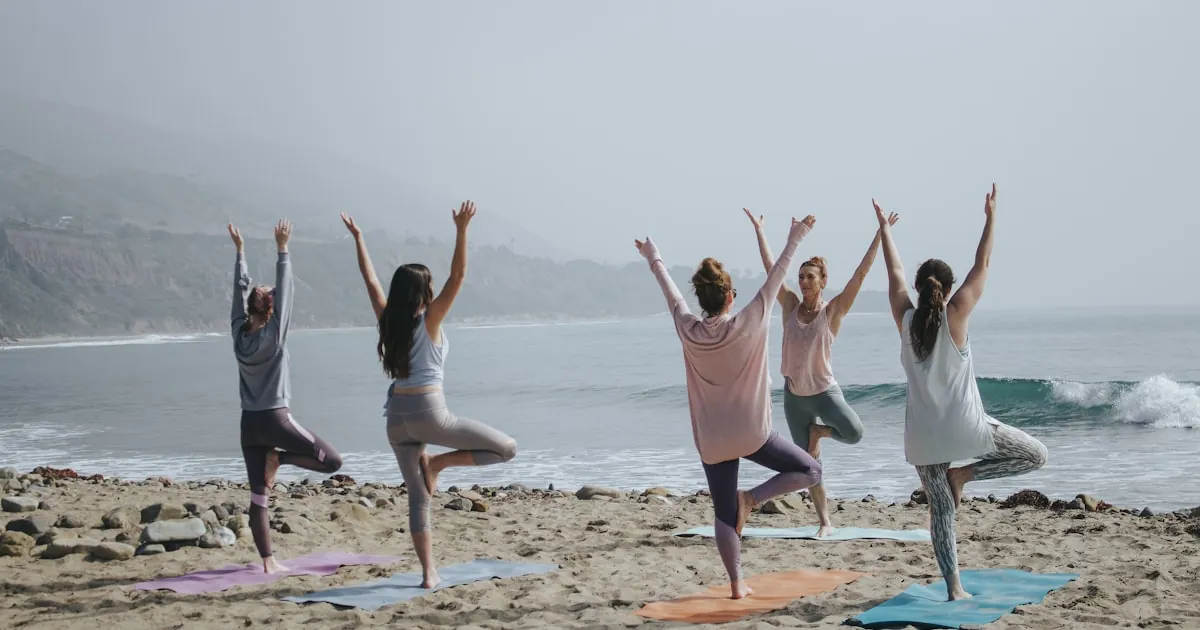
Starting yoga can feel confusing when you see advanced poses, complicated flows, and people bending into positions that seem impossible.
Beginner yoga does not need to look like that.
A good beginner yoga routine focuses on simple movements, controlled breathing, balance, mobility, body awareness, and gradual improvement. You do not need to be flexible before starting yoga. Flexibility can develop over time through regular practice.
This guide covers 15 beginner-friendly yoga exercises, explains how to perform them, what areas they work, how long to hold each pose, and how to combine them into a simple weekly routine.
Quick Answer: What Are the Best Yoga Exercises for Beginners?
Some of the easiest yoga poses for beginners include:
- Mountain Pose
- Child’s Pose
- Cat-Cow
- Downward-Facing Dog
- Standing Forward Fold
- Low Lunge
- Warrior I
- Warrior II
- Triangle Pose
- Chair Pose
- Tree Pose
- Cobra Pose
- Bridge Pose
- Supine Spinal Twist
- Corpse Pose
Beginners can start with approximately 10 to 20 minutes of yoga several times per week, focusing on comfortable movement rather than forcing deeper stretches.
The goal is not to make every pose look perfect.
The goal is to move with control, breathe comfortably, and gradually improve your strength, balance, and range of motion.
What Is Yoga?
Yoga is a broad practice with roots in Indian philosophy and traditions.
Modern yoga classes commonly include a combination of:
- Physical postures, often called asanas
- Breathing exercises
- Relaxation
- Meditation or mindfulness
Some forms of yoga are slow and gentle, while others are physically demanding.
For beginners, a slower style with clear instruction is usually easier for learning basic movements and understanding how the body responds.
Is Yoga Good for Beginners?
Yes.
Yoga can be adapted for different fitness levels, ages, and abilities.
Beginner yoga may help you practice:
- Flexibility
- Balance
- Muscular control
- Body awareness
- Coordination
- Relaxation
- Breathing control
- General physical activity
You do not need previous exercise experience to begin.
You also do not need to perform advanced poses such as headstands, deep backbends, or full splits.
In fact, beginners are generally better served by mastering simple foundational movements first.
What Are the Benefits of Yoga?
Research suggests yoga may support several aspects of wellness.
Potential benefits include:
- Improved balance
- Improved flexibility or range of motion
- Better body awareness
- Stress management
- Support for sleep
- Improved general well-being
- Strengthening certain muscle groups
- Improved movement control
Yoga has also been studied for several health conditions, including low-back pain, neck pain, and anxiety symptoms, although results vary depending on the type of yoga, population, and study.
Yoga should not be considered a replacement for appropriate medical treatment.
Does Yoga Improve Flexibility?
Yoga can help improve flexibility because many poses move joints through controlled ranges of motion and place muscles under gentle stretch.
Common areas that may become more mobile with regular practice include:
- Hamstrings
- Hips
- Calves
- Shoulders
- Chest
- Back
Flexibility improvements generally occur gradually.
Forcing yourself deeper into a stretch does not necessarily produce faster progress and can increase discomfort or injury risk.
Can Yoga Build Strength?
Yes, certain yoga poses require you to support or stabilize your body weight.
Examples include:
- Plank variations
- Downward-Facing Dog
- Chair Pose
- Warrior poses
- Bridge Pose
These movements can challenge muscles in the:
- Legs
- Glutes
- Core
- Shoulders
- Arms
- Back
However, yoga and progressive resistance training are not identical.
If maximizing muscular strength or muscle growth is your primary goal, structured resistance training can also be useful.
What Do You Need for Beginner Yoga?
You need very little equipment.
Useful items include:
- Yoga mat
- Comfortable clothing
- Water
- Yoga block
- Strap or towel
- Stable chair if you need extra support
Blocks and straps are not signs that you are doing yoga incorrectly.
They are tools that can make positions more accessible.
How Long Should Beginners Do Yoga?
There is no required session length.
A beginner can start with:
10 minutes: Short mobility or relaxation practice
15 to 20 minutes: Basic beginner flow
30 minutes: More complete yoga session
45 to 60 minutes: Longer class or structured practice
Consistency matters more than immediately performing long sessions.
Three short sessions that you actually complete may be more useful than planning a 90-minute routine that you never do.
How Often Should Beginners Do Yoga?
Beginners might start with yoga 2 to 4 times per week.
You can also perform short, gentle sessions more often if they feel comfortable.
For example:
Day | Activity |
Monday | 20-minute beginner yoga |
Tuesday | Walking or other activity |
Wednesday | 15-minute yoga |
Thursday | Rest or light activity |
Friday | 20-minute yoga |
Saturday | Optional gentle stretching |
Sunday | Rest |
Yoga can also complement walking, cardio, or strength training.
How to Breathe During Yoga
Breathing is an important part of yoga practice.
For beginners, keep it simple:
- Breathe naturally through the nose when comfortable.
- Avoid holding your breath during poses.
- Use slow, controlled breaths.
- Reduce the intensity of a pose if normal breathing becomes difficult.
You do not need to master complicated breathing techniques before beginning physical yoga.
Comfortable, steady breathing is enough.
Should You Warm Up Before Yoga?
Gentle yoga can serve as its own gradual warm-up, but starting slowly is still useful.
Begin with movements such as:
- Easy standing
- Shoulder rolls
- Gentle neck movement
- Cat-Cow
- Easy hip movement
- Slow breathing
Avoid jumping immediately into your deepest stretch.
Your range of motion may increase as your body warms up.
15 Easy Yoga Exercises for Beginners
1. Mountain Pose
Mountain Pose, or Tadasana, looks simple but helps teach posture, balance, and body awareness.
How to Do Mountain Pose
- Stand with your feet comfortably positioned.
- Distribute your weight evenly.
- Keep your knees relaxed rather than forcefully locked.
- Lengthen your spine.
- Let your arms rest beside your body.
- Relax your shoulders.
- Look straight ahead.
- Breathe slowly.
What It Works
Mountain Pose helps you practice:
- Posture
- Balance
- Standing alignment
- Body awareness
How Long to Hold
Start with 20 to 60 seconds.
2. Child’s Pose
Child’s Pose is commonly used as a resting position.
How to Do Child’s Pose
- Begin on your hands and knees.
- Move your hips gently toward your heels.
- Lower your upper body toward the mat.
- Extend your arms forward or let them rest beside you.
- Keep your breathing comfortable.
Do not force your hips toward your heels if the position feels uncomfortable.
Areas Stretched
You may feel a gentle stretch through the:
- Back
- Hips
- Shoulders
How Long to Hold
Try 20 to 60 seconds.
3. Cat-Cow Pose
Cat-Cow combines two positions and gently moves the spine.
How to Do Cat-Cow
Start on your hands and knees.
For Cow Pose:
- Allow your belly to lower gently.
- Lift your chest slightly.
- Look forward without compressing your neck.
For Cat Pose:
- Round your back gently.
- Allow your head to follow the movement naturally.
- Draw your abdomen inward slightly.
Move slowly between the two positions.
What It Works
Cat-Cow can help with:
- Spinal movement
- Body awareness
- Gentle warm-up
Repetitions
Perform approximately 5 to 10 slow cycles.
4. Downward-Facing Dog
Downward-Facing Dog is one of the most recognizable yoga poses.
It may initially feel challenging for beginners, particularly in the shoulders or hamstrings.
How to Do Downward-Facing Dog
- Start on your hands and knees.
- Place your hands firmly on the mat.
- Lift your knees.
- Move your hips upward and backward.
- Keep your spine long.
- Bend your knees if your hamstrings feel tight.
- Let your heels move toward the floor without forcing them.
Your heels do not need to touch the ground.
What It Works
This pose can challenge or stretch the:
- Shoulders
- Back
- Hamstrings
- Calves
- Arms
How Long to Hold
Start with 15 to 30 seconds.
5. Standing Forward Fold
Standing Forward Fold can provide a gentle stretch for the back of the legs.
How to Do It
- Stand comfortably.
- Bend forward from the hips.
- Keep your knees slightly bent.
- Allow your hands to reach toward your legs, blocks, or floor.
- Relax your neck.
Do not force your knees straight.
Areas Stretched
Common areas include:
- Hamstrings
- Calves
- Lower back
How Long to Hold
Hold for approximately 15 to 30 seconds.
6. Low Lunge
Low Lunge is useful for practicing hip mobility and balance.
How to Do It
- Begin on your hands and knees or from Downward-Facing Dog.
- Bring one foot forward between your hands.
- Lower the opposite knee onto the mat.
- Keep your front foot stable.
- Lift your torso if comfortable.
- Place your hands on your thigh or keep them supported on blocks.
Areas Worked
You may feel the pose in the:
- Hip flexors
- Thighs
- Glutes
How Long to Hold
Try 15 to 30 seconds per side.
7. Warrior I
Warrior I combines balance, leg strength, and hip mobility.
How to Do Warrior I
- Step one foot forward and the other foot back.
- Bend the front knee comfortably.
- Keep your back foot stable.
- Face your torso generally forward.
- Place your hands on your hips or raise your arms if comfortable.
- Keep breathing normally.
What It Works
Warrior I can challenge:
- Quadriceps
- Glutes
- Calves
- Core
- Shoulders
How Long to Hold
Try 15 to 30 seconds on each side.
8. Warrior II
Warrior II is a beginner-friendly standing pose that challenges the legs and balance.
How to Do Warrior II
- Take a wide stance.
- Turn your front foot outward.
- Bend your front knee.
- Keep your back leg relatively straight.
- Extend your arms horizontally.
- Look over your front hand.
- Keep your torso upright.
Avoid forcing the front knee deeply.
What It Works
This pose engages:
- Legs
- Glutes
- Core
- Shoulders
How Long to Hold
Start with 20 to 30 seconds per side.
9. Triangle Pose
Triangle Pose combines balance and stretching.
How to Do Triangle Pose
- Begin in a wide stance.
- Turn your front foot outward.
- Keep both legs comfortably extended.
- Reach your torso toward the front leg.
- Place your lower hand on your shin or a yoga block.
- Extend the opposite arm upward if comfortable.
Do not force your hand to the floor.
Areas Worked or Stretched
Triangle Pose may involve:
- Hamstrings
- Hips
- Side body
- Shoulders
- Core
How Long to Hold
Try 15 to 30 seconds per side.
10. Chair Pose
Chair Pose can be surprisingly challenging.
How to Do Chair Pose
- Stand with your feet comfortably positioned.
- Bend your knees.
- Move your hips backward as if sitting toward a chair.
- Keep your chest lifted.
- Place your hands at your chest or raise your arms.
- Keep your weight balanced.
What It Works
Chair Pose primarily challenges the:
- Quadriceps
- Glutes
- Core
How Long to Hold
Start with 10 to 30 seconds.
11. Tree Pose
Tree Pose is a common balance exercise.
How to Do Tree Pose
- Stand tall.
- Shift your weight onto one leg.
- Place the other foot against your ankle, lower leg, or inner thigh.
- Avoid pressing directly into the knee joint.
- Keep your hands at your chest or use a wall for support.
- Focus your eyes on a fixed point.
What It Works
Tree Pose challenges:
- Balance
- Ankle stability
- Leg control
- Core control
How Long to Hold
Try 10 to 30 seconds per side.
Beginners can keep one toe touching the floor.
12. Cobra Pose
Cobra Pose is a gentle backbend when performed within a comfortable range.
How to Do Cobra Pose
- Lie on your stomach.
- Place your hands near your chest.
- Keep your elbows relatively close to your sides.
- Gently lift your chest using your back muscles and light hand support.
- Keep the movement comfortable.
- Avoid forcing yourself into a deep backbend.
Areas Worked
Cobra may involve:
- Back muscles
- Chest
- Shoulders
How Long to Hold
Start with 10 to 20 seconds.
13. Bridge Pose
Bridge Pose works the hips and posterior chain.
How to Do Bridge Pose
- Lie on your back.
- Bend your knees.
- Place your feet on the floor.
- Keep your arms beside your body.
- Press through your feet.
- Lift your hips to a comfortable height.
- Keep your neck relaxed.
- Lower slowly.
What It Works
Bridge Pose can strengthen:
- Glutes
- Hamstrings
- Back muscles
Repetitions or Hold
You can either hold for 15 to 30 seconds or perform 5 to 10 controlled repetitions.
14. Supine Spinal Twist
This is a gentle floor-based rotation.
How to Do It
- Lie on your back.
- Bend your knees.
- Bring the knees gently toward one side.
- Keep your shoulders comfortable on the floor.
- Turn your head only if that feels comfortable.
- Breathe slowly.
Areas Stretched
You may feel movement through the:
- Back
- Hips
- Torso
How Long to Hold
Try 20 to 30 seconds per side.
15. Corpse Pose
Corpse Pose, or Savasana, is typically used at the end of a yoga practice.
It may look like simply lying down, but the purpose is intentional relaxation.
How to Do Corpse Pose
- Lie comfortably on your back.
- Let your arms rest beside your body.
- Allow your feet to relax.
- Close your eyes if comfortable.
- Breathe naturally.
- Relax areas of unnecessary muscular tension.
How Long to Hold
Beginners can try 2 to 5 minutes.
Longer relaxation periods are also common.
15-Pose Beginner Yoga Sequence
If you want to combine the exercises into one routine, use this order:
- Mountain Pose
- Standing Forward Fold
- Cat-Cow
- Downward-Facing Dog
- Low Lunge
- Warrior I
- Warrior II
- Triangle Pose
- Chair Pose
- Tree Pose
- Cobra Pose
- Bridge Pose
- Child’s Pose
- Supine Spinal Twist
- Corpse Pose
Move slowly.
There is no need to transition quickly between poses.
10-Minute Beginner Yoga Routine
If you have limited time, try:
Mountain Pose: 30 seconds
Cat-Cow: 1 minute
Downward Dog: 30 seconds
Low Lunge: 30 seconds each side
Warrior II: 30 seconds each side
Chair Pose: 20 seconds
Bridge Pose: 30 seconds
Child’s Pose: 1 minute
Supine Twist: 30 seconds each side
Corpse Pose: Remaining time
This can be adjusted according to your ability.
20-Minute Yoga Routine for Beginners
A slightly longer practice could include:
Warm-Up
Mountain Pose
Cat-Cow
Standing Forward Fold
Standing Sequence
Low Lunge
Warrior I
Warrior II
Triangle Pose
Chair Pose
Tree Pose
Floor Sequence
Cobra Pose
Bridge Pose
Child’s Pose
Supine Spinal Twist
Relaxation
Corpse Pose
Spend approximately 20 to 60 seconds on each position, depending on comfort and whether the pose is performed on both sides.
Yoga Exercises for Flexibility
If flexibility is your main goal, beginner-friendly poses may include:
- Standing Forward Fold
- Low Lunge
- Downward-Facing Dog
- Triangle Pose
- Child’s Pose
- Supine Spinal Twist
Focus on gentle tension rather than pain.
A stretch does not need to feel extreme to be useful.
Yoga Exercises for Strength
For more strength-focused beginner practice, emphasize:
- Chair Pose
- Warrior I
- Warrior II
- Downward-Facing Dog
- Bridge Pose
- Tree Pose
Longer holds may increase muscular challenge, but technique should remain controlled.
Yoga for Balance
Balance can be trained like other physical skills.
Useful poses include:
- Mountain Pose
- Tree Pose
- Warrior I
- Warrior II
- Triangle Pose
Use a wall, chair, or stable surface when needed.
There is no benefit in repeatedly falling simply to avoid using support.
Beginner Yoga for Tight Hips
Several beginner movements can gently work hip mobility, including:
- Low Lunge
- Warrior I
- Warrior II
- Child’s Pose
- Supine Twist
Individual anatomy differs, so not everyone will look the same in these poses.
Do not force your hips into an artificial position simply to copy an instructor.
Beginner Yoga for Tight Hamstrings
Useful options include:
- Downward-Facing Dog with bent knees
- Standing Forward Fold with bent knees
- Triangle Pose with a yoga block
Bending the knees is not "cheating."
It can help you maintain a more comfortable position while gradually working on mobility.
Is Yoga Good for Back Pain?
Yoga has been studied for low-back pain, and research suggests it may offer a modest benefit for some people.
However, back pain has many possible causes.
A general online yoga routine should not be treated as an individualized treatment plan.
If you have persistent, severe, unexplained, or worsening back pain, seek appropriate medical evaluation.
People with diagnosed spine conditions may also require specific modifications.
Can Yoga Help With Stress?
Yoga often combines physical movement, slower breathing, and focused attention.
Research suggests yoga may help some people manage perceived stress and support aspects of mental and emotional well-being.
However, yoga is not a substitute for professional mental healthcare when treatment is needed.
Can Yoga Help With Sleep?
Some studies suggest yoga may support sleep in certain populations.
A calm evening routine might include:
- Child’s Pose
- Gentle Supine Twist
- Slow breathing
- Corpse Pose
Avoid assuming that one yoga routine will treat persistent insomnia.
Long-lasting sleep problems may require broader evaluation.
Does Yoga Help With Weight Loss?
Yoga is physical activity and can contribute to an active lifestyle.
However, body-weight change depends on many factors, including:
- Energy intake
- Overall physical activity
- Body size
- Sleep
- Health status
- Individual physiology
Some yoga styles are considerably more physically demanding than others.
Yoga should not be marketed as a guaranteed rapid weight-loss method.
Common Beginner Yoga Mistakes
Trying to Copy Advanced Practitioners
Your anatomy, flexibility, strength, and training history are different.
Use the version of the pose appropriate for you.
Forcing Flexibility
Pain is not evidence that a stretch is more effective.
Holding Your Breath
Reduce the intensity if you cannot breathe comfortably.
Locking the Joints
Avoid aggressively forcing the knees or elbows into their end range.
Ignoring Props
Blocks, straps, walls, and chairs can make yoga more accessible.
Moving Too Quickly
Beginners often benefit from slower transitions.
Expecting Instant Flexibility
Mobility changes gradually.
Practicing Through Sharp Pain
Stop or modify the position.
Yoga should not require ignoring warning signs from your body.
What Should Yoga Feel Like?
Depending on the pose, you may feel:
- Gentle muscular effort
- Mild stretching
- Balance challenge
- Increased breathing
- Relaxation
You should not try to push through:
- Sharp pain
- Sudden joint pain
- Severe dizziness
- Numbness
- Significant breathing difficulty
- Pain that worsens with movement
Modify or stop the movement if something feels wrong.
Is Yoga Safe for Beginners?
Yoga is generally considered safe for healthy people when practiced appropriately.
However, injuries can occur.
Common yoga-related injuries include sprains and strains.
New practitioners should avoid assuming that advanced positions are required. Extreme poses such as headstands, shoulder stands, and complex deep positions are not necessary for a beginner routine.
A qualified instructor can also help you learn safer technique.
Who Should Be More Careful With Yoga?
Individual modifications may be necessary for people who:
- Are pregnant
- Are older adults with balance concerns
- Have existing knee or hip injuries
- Have certain spinal conditions
- Have severe high blood pressure
- Have glaucoma
- Are recovering from surgery
- Have other medical conditions affecting exercise
If you are unsure whether yoga is appropriate for you, speak with an appropriate healthcare professional and inform your yoga instructor about relevant limitations.
Should Beginners Try Hot Yoga?
Hot yoga takes place in an intentionally heated environment.
It is not necessary for gaining the basic benefits of yoga.
Heat introduces additional concerns, including:
- Overheating
- Dehydration
- Feeling light-headed
Beginners can learn foundational yoga effectively in a normal-temperature environment.
Morning vs Evening Yoga: Which Is Better?
There is no universal best time.
Morning yoga may help you:
- Establish a routine
- Move after waking
- Start the day with physical activity
Evening yoga may suit people who:
- Prefer exercising after work
- Want a gentler pre-bed routine
- Feel more mobile later in the day
Choose the time that allows you to practice consistently.
Can You Do Yoga Every Day?
Gentle yoga can be practiced frequently if it feels comfortable.
However, every session does not need to be difficult.
A balanced week might include:
Monday: Moderate yoga
Tuesday: Walking
Wednesday: Yoga
Thursday: Strength training or rest
Friday: Yoga
Saturday: Light activity
Sunday: Rest
Your overall activity schedule should consider recovery from all forms of exercise, not yoga in isolation.
Yoga vs Stretching: Are They the Same?
No.
Stretching is one component that may occur during yoga.
Yoga can also include:
- Strength
- Balance
- Controlled movement
- Breathing
- Body awareness
- Meditation
- Relaxation
A yoga session may therefore be broader than a conventional stretching routine.
Yoga vs Pilates
Yoga and Pilates overlap in some areas, but they are different systems.
Both may involve:
- Controlled movement
- Core engagement
- Balance
- Mobility
- Breathing
Yoga has historical roots in Indian philosophical and spiritual traditions, while Pilates developed as a modern physical conditioning method.
Neither is automatically superior.
The best choice depends on your preferences and goals.
A Simple 4-Week Beginner Yoga Plan
Week 1
Practice 10 to 15 minutes, twice per week.
Focus on:
- Mountain Pose
- Cat-Cow
- Child’s Pose
- Low Lunge
- Bridge Pose
- Corpse Pose
Week 2
Practice 15 to 20 minutes, 2 to 3 times per week.
Add:
- Downward-Facing Dog
- Warrior I
- Warrior II
Week 3
Continue 2 to 3 sessions.
Add:
- Triangle Pose
- Chair Pose
- Tree Pose
Spend more time learning controlled transitions.
Week 4
Try the complete 15-pose routine.
Increase duration only if the routine feels manageable.
The goal after four weeks is not advanced flexibility.
The goal is greater familiarity, confidence, and consistency.
How to Progress in Yoga
Progress does not only mean performing deeper poses.
You may be progressing when you can:
- Balance longer
- Breathe more comfortably
- Control transitions better
- Maintain posture more easily
- Move through a larger comfortable range
- Practice more consistently
- Need less support
- Hold strength-based positions longer
These improvements matter even if your poses do not look dramatically different.
Frequently Asked Questions
The Bottom Line
Yoga does not have to involve complicated poses.
A beginner can build a useful routine around simple movements such as Mountain Pose, Cat-Cow, Downward-Facing Dog, Low Lunge, Warrior poses, Bridge Pose, Tree Pose, and Child’s Pose.
These exercises can help you practice flexibility, balance, muscular control, movement, and relaxation.
Start with approximately 10 to 20 minutes, move through a comfortable range, and use support whenever necessary.
Over time, your practice can progress through better balance, greater control, improved range of motion, longer holds, and increased consistency.
You do not need to touch your toes, perform the splits, or stand on your head to be "good" at yoga.
For a beginner, the most useful yoga practice is one that is safe, sustainable, and appropriate for your current ability.
How to Build Muscle: A Beginner’s Guide to Traini…