You may have heard that watermelon has a high glycemic index, so you should avoid it if you're concerned about blood sugar.
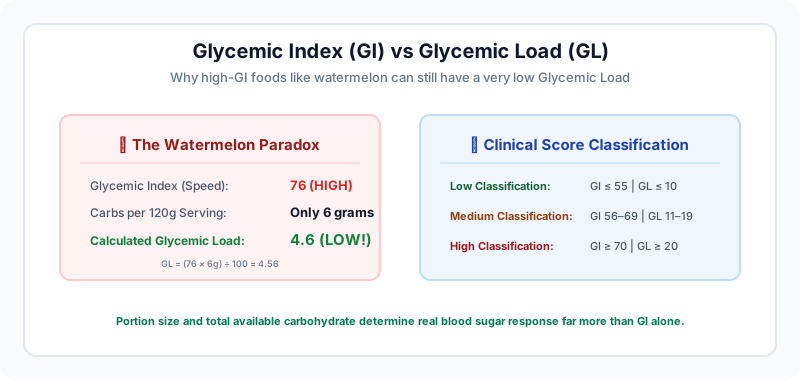
But here's something surprising: a typical serving of watermelon contains relatively little carbohydrate, so its glycemic load can be low.
Meanwhile, you could eat a large portion of a food with a moderate glycemic index and consume considerably more carbohydrate.
How can both be true?
The answer comes down to the difference between glycemic index (GI) and glycemic load (GL).
Glycemic index describes how a carbohydrate-containing food affects blood glucose under standardized testing conditions. Glycemic load takes things further by considering how much available carbohydrate you actually eat.
Understanding the difference can help you make sense of food comparisons, serving sizes, and blood sugar advice without feeling that you need to avoid every food labeled "high GI."
This guide explains GI and GL in plain English, shows you how to calculate glycemic load, and explores what these numbers can—and cannot—tell you about your meals.
Glycemic Index vs Glycemic Load: What's the Difference?
Glycemic index measures the relative blood glucose response to a fixed amount of available carbohydrate from a food. Glycemic load combines that GI value with the amount of available carbohydrate in an actual serving.
Here's the comparison:
Feature | Glycemic Index (GI) | Glycemic Load (GL) |
What it measures | Relative blood glucose response to a carbohydrate-containing food | GI adjusted for carbohydrate quantity in a serving |
Considers portion size? | No | Yes |
Main question | How does this food perform in standardized testing? | How much glycemic impact might this portion represent? |
Low category | 55 or less | 10 or less per serving |
Medium category | 56–69 | 11–19 per serving |
High category | 70 or above | 20 or above per serving |
Main limitation | Doesn't account for how much you eat | Still doesn't predict an individual's exact blood glucose response |
The simplest way to remember it:
GI describes a food's tested carbohydrate response. GL adjusts that response for the amount of carbohydrate in your portion.
Neither is a complete measure of how healthy a food is.
What Is the Glycemic Index (GI)?
The glycemic index is a numerical ranking used to compare the blood glucose effects of carbohydrate-containing foods.
In standard GI testing, researchers measure the blood glucose response after participants consume a portion of food containing a specified amount of available carbohydrate, commonly 50 grams.
They compare that response with a reference food, typically glucose, under standardized conditions.
Glucose is assigned a GI of 100.
Foods are then categorized as:
GI Score | Category |
55 or below | Low |
56–69 | Medium |
70 or above | High |
What Does a GI of 40 Mean?
A GI of 40 means the tested food produced approximately 40% of the reference glucose response, measured using the incremental blood glucose response area under the curve under the testing conditions.
It doesn't mean:
- The food contains 40 grams of sugar.
- Your blood sugar will rise by 40%.
- The food has 40 calories.
- Everyone will respond to it in exactly the same way.
This distinction is important.
GI values are based on standardized testing, not a prediction of an individual's exact glucose reading after a normal meal.
Examples of Foods Commonly Considered Lower GI
Depending on the variety and preparation method, examples can include:
- Lentils
- Chickpeas
- Many beans
- Apples
- Pears
- Steel-cut oats
- Some types of pasta cooked al dente
- Certain whole-grain foods
But you shouldn't assume a food has a particular GI based only on its appearance or whether its packaging says "whole grain."
Two products made from similar ingredients can have different measured GI values.
What Is Glycemic Load (GL)?
Glycemic load builds on the glycemic index by including the quantity of available carbohydrate in a serving.
It helps answer a more practical question:
Does the amount of this food I'm eating contain enough available carbohydrate to produce a substantial calculated glycemic load?
For example, a food may have a relatively high GI but contain only a small amount of available carbohydrate in a normal serving.
Its glycemic load could still be low.
Alternatively, a large serving of a moderate-GI food may have a high glycemic load because it contains plenty of available carbohydrate.
Glycemic Load Categories
Glycemic Load per Serving | Interpretation |
10 or less | Low |
11–19 | Medium |
20 or more | High |
Unlike GI, GL changes with your portion size.
A larger serving of the same food generally contains more available carbohydrate and therefore has a greater glycemic load.
This is why GL can offer useful context that GI alone misses.
How to Calculate Glycemic Load Step by Step
The formula is:
Glycemic Load = (Glycemic Index × Available Carbohydrate in Grams) ÷ 100
Available carbohydrate refers to carbohydrate that can be digested and absorbed, rather than dietary fiber that is not digested in the same way.
Example 1: An Apple
Suppose an apple has:
- Glycemic index: 40
- Available carbohydrate in the serving: 15 g
Calculate:
GL = (40 × 15) ÷ 100
GL = 6
That places this apple serving in the low-GL category.
These values are a commonly used illustrative apple example, not a guarantee for every apple variety or size.
Example 2: A Serving of Rice
Suppose a rice variety has:
- Glycemic index: 70
- Available carbohydrate in the portion: 30 g
Calculate:
GL = (70 × 30) ÷ 100
GL = 21
That would be classified as high GL.
But if you ate a smaller portion containing only 15 g of available carbohydrate:
GL = (70 × 15) ÷ 100
GL = 10.5
The GI stayed the same, but the calculated GL fell because the serving contained less carbohydrate.
This example uses a hypothetical GI and portion amount. Different rice varieties and cooking methods produce different values.
Example 3: Why Portion Size Matters
Imagine two portions of the same food, both with GI 50.
Serving | Available Carbohydrate | Calculated GL |
Small portion | 15 g | 7.5 |
Medium portion | 30 g | 15 |
Large portion | 60 g | 30 |
A food's GI doesn't change just because you eat more of it.
But its glycemic load increases as the amount of available carbohydrate increases.
Practical takeaway: Serving size can matter just as much as the food's GI classification.
Glycemic Index and Glycemic Load Food Examples
The following examples illustrate typical food patterns rather than precise values for every brand, recipe, or variety.
Food | General GI Pattern | What Matters for GL |
Lentils | Often low | Portion size and available carbohydrate |
Chickpeas | Often low | Quantity eaten and preparation |
Apple | Usually low | Fruit size and carbohydrate content |
Watermelon | Can be high | A normal portion contains relatively little carbohydrate |
White rice | Varies; some varieties are high | Rice variety and serving size |
Varies by type and preparation | Not automatically lower GI than every white rice | |
White bread | Often high | Slice size and available carbohydrate |
Pasta | Often low to medium | Portion size, ingredients, and cooking method |
Potatoes | Highly variable | Type, preparation, and serving size |
Oats | Varies | Instant versus less-processed varieties |
For exact GI comparisons, use a properly tested value for the specific food or product rather than assuming every item within a food category has the same GI.
Why Does Watermelon Have a High GI but a Low GL?
Watermelon is one of the clearest examples of why GI and GL are not interchangeable.
Harvard Health describes an example of watermelon with a GI of approximately 80, while a typical serving has a glycemic load of about 5.
Why the difference?
Watermelon contains a large amount of water and relatively little carbohydrate per typical serving.
Its carbohydrate can produce a relatively strong glucose response when standardized to the test quantity.
But the amount of available carbohydrate in an ordinary portion is much smaller.
So its glycemic load can remain low.
Does That Mean You Can Eat Unlimited Watermelon?
No.
GL depends on portion size. Eating much larger amounts increases the carbohydrate consumed and therefore the calculated glycemic load.
But a high GI alone is not a good reason to label watermelon unhealthy.
Watermelon also contributes water and nutrients, and it can fit into a balanced eating pattern.
The lesson: A food's glycemic index doesn't tell you everything about the portion you're eating.
Brown Rice vs White Rice: Which Has a Lower GI?
You may have heard that brown rice is always better for blood sugar than white rice.
The reality is more complicated.
GI varies with:
- Rice variety
- Starch structure
- Processing
- Cooking method
- Texture
- Other food characteristics
Some brown rice varieties have lower GI values than certain white rice varieties.
However, this isn't a universal rule.
Some white rice varieties, including certain basmati or parboiled types, can have a relatively moderate GI.
And some brown rice products can produce higher glycemic responses than people expect.
What Should You Choose?
Instead of relying only on the color of the rice, consider:
- The type of rice
- Your portion size
- Fiber content
- Your overall meal
- Your individual glucose response, when relevant
Brown rice may provide more fiber and certain nutrients than a comparable refined variety, but you don't need to assume white rice is forbidden.
For more information about nutritious carbohydrate sources, see our Carbohydrates and Whole Grains Guide.
Does Cooking Change the Glycemic Index?
Yes, cooking and processing can affect how readily starch is digested.
But the effect depends on the food.
Pasta: Al Dente vs Soft
Pasta cooked until firm may have a different glycemic response than pasta cooked until very soft.
Cooking changes starch structure and accessibility.
Still, you shouldn't assume an exact GI reduction simply from the number of minutes pasta was boiled.
Potatoes
Different potato varieties and preparation methods can produce different GI values.
Mashed potatoes, baked potatoes, and boiled potatoes aren't necessarily equivalent in their glycemic responses.
Oatmeal
Steel-cut oats and instant oats can differ in processing and digestion rate.
However, exact GI values depend on the product and preparation.
Does Cooling Rice Lower Its Glycemic Impact?
Cooling cooked starches can promote the formation of some resistant starch.
This may affect digestion and glucose response, but the magnitude varies and shouldn't be treated as a reliable way to transform every rice dish into a low-GI food.
For food safety, cool and refrigerate rice promptly rather than leaving it at room temperature.
If you're interested in weighing rice and pasta properly, see our Raw vs Cooked Food Calories Guide.
Does Eating Protein or Fat With Carbs Change Blood Sugar Response?
Yes, meal composition can influence how quickly food is digested and how blood glucose changes afterward.
Consider two situations.
Meal A: White toast eaten on its own.
Meal B: White toast with eggs and avocado.
The second meal includes protein and fat, which may change the timing and pattern of the glucose response.
However, the actual effect varies between people and depends on portions, ingredients, and other factors.
Adding protein or fat doesn't erase the carbohydrate in the toast.
It also doesn't automatically make an unlimited amount of carbohydrate appropriate for everyone.
A More Useful Approach
Rather than trying to calculate a precise GI value for every mixed meal, build meals with a reasonable balance of:
- Carbohydrate-rich foods
- Protein sources
- Vegetables or fruit
- Appropriate sources of dietary fat
For example, rice with lentils and vegetables provides a different overall nutritional profile from plain rice alone.
The goal is to create satisfying, balanced meals—not manipulate a single number.
Which Matters More for Blood Sugar: GI, GL, or Total Carbs?
This is arguably the most important question in the entire discussion.
GI and GL can provide information, but neither is a complete predictor of what will happen to your blood glucose.
The American Diabetes Association's 2026 Standards of Care notes that research on GI and GL has produced mixed findings.
The association also emphasizes individualized nutrition guidance.
1. Total Carbohydrate Matters
The amount of carbohydrate consumed is an important factor in the blood glucose response.
If you double a serving of carbohydrate-containing food, you've generally increased the carbohydrate your body needs to process.
2. Type of Carbohydrate Matters
Foods differ in fiber content, processing, and starch characteristics.
Beans, whole grains, fruit, and refined grain products don't all have the same nutritional properties.
3. Meal Composition Matters
Protein, fat, fiber, and other meal components can change digestion and the pattern of glucose response.
4. Your Body's Response Matters
Blood glucose responses can vary according to:
- Insulin sensitivity
- Diabetes status
- Medication
- Physical activity
- Meal timing
- Starting blood glucose level
- Individual physiology
A GI number can't capture all these factors.
Practical conclusion: Use GI and GL as optional educational tools. For diabetes management, appropriate carbohydrate planning and individualized blood glucose guidance are often more useful than choosing foods by GI alone.
Are Low-GI Foods Always Healthier?
No.
A low GI doesn't automatically mean a food is nutritious.
Likewise, a high GI doesn't automatically make a food unhealthy.
Consider these examples:
- Some foods rich in fat may have a relatively low GI while also containing substantial saturated fat.
- Certain fruits may have a relatively high GI but provide water, vitamins, and other beneficial nutrients.
- A low-GI processed snack may contain considerable calories or sodium.
- A higher-GI food may still fit appropriately into an otherwise balanced meal.
Food quality involves more than blood sugar response.
Also consider:
- Fiber
- Protein
- Vitamins and minerals
- Fat quality
- Sodium
- Added sugars
- Serving size
- Overall dietary pattern
A useful food choice shouldn't depend on a single number.
Can Glycemic Load Help With Weight Loss?
Glycemic load may help people think more carefully about carbohydrate portions, but it is not a weight-loss formula.
A food with low GL isn't necessarily low in calories.
For example, some foods contain little available carbohydrate but are energy-dense because of their fat content.
Weight management depends on multiple factors, including overall food intake, physical activity, sleep, eating patterns, and individual circumstances.
Choosing fiber-rich foods and satisfying meals can be useful, but you don't need to calculate GL for every food to manage your weight.
For a more complete explanation, read our Calorie Deficit Guide.
Should People With Diabetes Follow a Low-GI Diet?
Some people with diabetes may find GI information useful when comparing carbohydrate-containing foods.
However, diabetes management shouldn't be based on GI rankings alone.
The American Diabetes Association has highlighted several limitations of GI, including substantial individual variation in glucose response and the effect of other meal and lifestyle factors.
For many people, practical strategies include:
- Understanding carbohydrate portions
- Choosing nutrient-rich carbohydrate sources
- Eating adequate fiber
- Balancing meals
- Following individualized medication and nutrition plans
- Monitoring blood glucose when recommended
People using insulin or medications that can cause low blood glucose may need specific carbohydrate advice, particularly around exercise.
Do not make medication or major carbohydrate-intake changes solely on the basis of GI or GL calculations.
A registered dietitian experienced in diabetes care can help translate nutrition information into an individualized plan.
How to Use GI and GL in Everyday Meals
You don't need to memorize food charts.
Try this practical approach instead.
Breakfast
If you usually eat a refined cereal that leaves you hungry soon afterward, experiment with oats, yogurt, fruit, or another fiber- and protein-containing breakfast.
Lunch
If you enjoy rice, keep eating rice if it suits your dietary needs.
Consider the portion and add beans, vegetables, chicken, tofu, or another protein source.
Snacks
Choose foods based on their overall nutrition and your needs, not GI alone.
Fruit, yogurt, nuts, and other familiar foods can be useful options.
Dinner
Build a meal containing vegetables, an appropriate carbohydrate portion, and a source of protein.
You don't need to calculate a glycemic load for every component.
When Comparing Packaged Foods
Look at:
- Serving size
- Total carbohydrate
- Dietary fiber
- Ingredients
- Protein and other nutrients
- Relevant individual dietary needs
Nutrition Facts labels typically don't provide a tested GI value.
For help understanding the label, read our How to Read Nutrition Facts Labels Guide.
Common Mistakes When Using GI and GL
Mistake 1: Assuming High GI Means High Sugar
GI reflects a measured glucose response, not how many grams of sugar a food contains.
Mistake 2: Ignoring Portion Size
A moderate-GI food can have a high calculated GL when eaten in a large amount.
Mistake 3: Treating a GI Chart as Exact for Every Product
Food variety, manufacturing, ripeness, and cooking can affect GI.
Mistake 4: Assuming Low GI Means Low Calories
GI does not measure calories or total nutritional quality.
Mistake 5: Using Total Carbohydrate Incorrectly
The GL formula uses available carbohydrate, and carbohydrate-labeling conventions differ between countries.
For U.S. labels, dietary fiber is included within Total Carbohydrate. For a simplified estimate, available carbohydrate is often approximated by subtracting dietary fiber, although fiber fractions, sugar alcohols, and other details can complicate the calculation.
Mistake 6: Predicting Your Exact Blood Glucose From GL
GL is a calculated index, not a personal blood glucose forecast.
Mistake 7: Avoiding Nutritious Foods Because of One Number
Watermelon, potatoes, rice, and other carbohydrate-containing foods should be evaluated in the context of portions and overall dietary needs.
Interactive Glycemic Load (GL) Calculator
Calculate real blood glucose impact using the official formula: (GI × Available Carbs) ÷ 100.
Frequently Asked Questions
What is the main difference between glycemic index and glycemic load?
GI measures the relative blood glucose response to a standardized amount of available carbohydrate. GL adjusts that GI value for the amount of available carbohydrate in a particular portion.
Which is better, GI or GL?
GL adds useful portion-size context, but neither measure is automatically the best guide for everyone's food choices. Overall carbohydrate intake, food quality, and individual responses matter too.
What is considered a low glycemic load?
A GL of 10 or less per serving is generally classified as low. A GL of 11–19 is medium, and 20 or above is high.
How do you calculate glycemic load?
Multiply the food's GI by the grams of available carbohydrate in your serving, then divide by 100.
For example:
GI 50 × 20 g available carbohydrate ÷ 100 = GL 10.
Is watermelon high in glycemic index?
Some tested watermelon examples have a high GI, but a normal serving can have a low GL because watermelon contains relatively little carbohydrate per serving.
Is brown rice always lower GI than white rice?
No. GI depends on the variety, processing, preparation, and other factors. Brown rice often provides more fiber than comparable white rice, but its GI isn't universally lower.
Is a low-GI diet the same as a low-carb diet?
No. GI concerns the quality of the standardized carbohydrate response, while a low-carbohydrate diet limits the total amount of carbohydrate. Low-GI foods can still contain substantial carbohydrate.
Do protein and fat lower the GI of a meal?
Protein and fat can alter digestion and the glucose response to mixed meals. However, a mixed meal's response can't be accurately predicted simply by adding protein or fat to a high-GI food.
Can glycemic load predict blood sugar spikes?
Not precisely. GL provides a calculated estimate based on GI and available carbohydrate, but individual blood glucose responses vary.
Should I use GI or GL if I have diabetes?
Use these measures only as optional aids alongside an individualized diabetes nutrition plan. Total carbohydrate, food quality, medication, and measured glucose patterns can be more directly useful.
Final Thoughts: Food Portions Matter More Than a GI Number Alone
Glycemic index and glycemic load are related, but they answer different questions.
GI tells you how a food's carbohydrate performs in standardized blood glucose testing.
GL adds the amount of available carbohydrate in the portion you're eating.
That's why a food with a high GI can have a low GL, and a large serving of a moderate-GI food can produce a higher calculated GL.
But neither number tells you whether a food is universally healthy, whether you should avoid it, or exactly how your own blood glucose will respond.
The most practical approach is to consider carbohydrate quantity, food quality, portion size, and your individual needs together.
You don't need a perfect GI chart to eat well.
Understanding these concepts should help you make more informed decisions—not make everyday eating more complicated.