Standing in the grocery store, holding two boxes of cereal, and wondering which one is healthier? One says "high in protein," while the other claims "made with whole grains." Both look like good choices, but their Nutrition Facts labels tell different stories.
You don't need to be a nutrition expert to figure it out.
Learning how to read nutrition labels helps you answer everyday questions: How many calories am I actually eating? Is this food high in sugar? What does 20% Daily Value mean? And how can I compare two products when their serving sizes are different?
This guide breaks everything down using simple explanations, realistic food examples, and practical shopping tips.
By the end, you'll know how to read a U.S. Nutrition Facts label and use that information to make food choices that fit your needs.
How to Read a Nutrition Label in 5 Easy Steps
If you only have 30 seconds to check a food package, follow these steps:
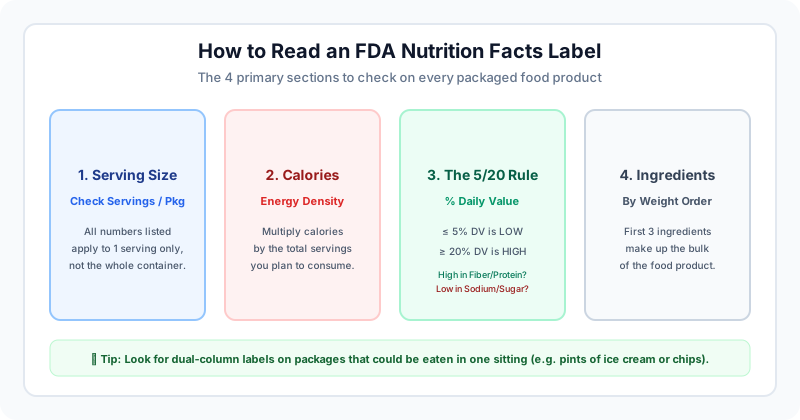
- Check the serving size. The numbers usually represent one serving, not the entire package.
- Look at the calories. Calculate how many you'll consume based on your actual portion.
- Check key nutrients. Focus on sodium, saturated fat, added sugars, fiber, and protein.
- Read the % Daily Value. Generally, 5% DV or less is low, and 20% DV or more is high.
- Compare similar products. Look at equivalent portions and consider ingredients and your individual nutritional needs.
Here's the key: A nutrition label doesn't tell you whether a food is automatically good or bad. It gives you information to decide how that food fits into your diet.
1. Start With Serving Size — It's More Important Than You Think
Imagine you pick up a bag of chips.
The front says "150 calories," so you assume eating the bag will give you 150 calories.
But then you check the Nutrition Facts:
Label Information | Amount |
Serving size | 28 g |
Servings per container | 3 |
Calories per serving | 150 |
Total fat per serving | 9 g |
Sodium per serving | 180 mg |
What happens if you eat the whole bag?
You consume three servings, not one.
That means:
- Calories: 150 × 3 = 450 calories
- Total fat: 9 × 3 = 27 g
- Sodium: 180 × 3 = 540 mg
These numbers are hypothetical, but the problem is real: overlooking servings per container can lead to inaccurate nutrition tracking.
Is serving size the amount you're supposed to eat?
No.
According to the U.S. FDA, serving sizes reflect how much people typically eat or drink. They are not recommendations about how much you personally should consume.
For example, if a cereal label says "1 cup per serving," that doesn't mean one cup is the ideal breakfast portion for everyone.
Your portion might be larger or smaller depending on your appetite, activity level, and nutritional needs.
What if you eat half a serving?
You can adjust the numbers.
Suppose one serving of crackers contains 200 calories.
If you eat half a serving:
200 × 0.5 = 100 calories
If you eat 1.5 servings:
200 × 1.5 = 300 calories
Useful takeaway: Before checking any other number, ask yourself, "How much of this food am I actually going to eat?"
2. Understand Calories Without Getting Confused
Calories tell you how much energy a food provides.
Your body uses energy for everything from breathing and digestion to walking, working, and exercising.
A food containing 300 calories provides more energy than one containing 150 calories, but that doesn't automatically mean it's less nutritious.
Example: Nuts vs Candy
Consider these hypothetical snacks:
Food | Calories | What Else It Provides |
Small portion of almonds | 170 | Protein, fiber, unsaturated fats |
Small candy serving | 100 | Primarily carbohydrates and sugars |
If you judge only by calories, the candy looks like the obvious choice.
But almonds supply nutrients that help support a balanced diet and may contribute to fullness.
This doesn't mean candy must be avoided. It simply shows why calories shouldn't be the only number you consider.
Why does the label mention 2,000 calories?
You'll usually see this statement near the bottom of U.S. Nutrition Facts labels:
"2,000 calories a day is used for general nutrition advice."
The figure is a general reference, not a personalized calorie requirement.
Your energy needs depend on factors such as your age, height, weight, sex, and activity level.
For a more detailed explanation, explore our Daily Calorie Guide.
Remember: Use calories to understand energy intake, not as the only measure of food quality.
3. Which Nutrients Should You Check First?
One of the biggest mistakes people make is trying to analyze every number on the label equally.
A more practical approach is to identify the nutrients most relevant to your health goals.
Here are the main ones worth understanding.
Saturated Fat: Compare Amounts, Not Just Total Fat
Some foods contain substantial amounts of fat but can still be part of a nutritious diet.
For example, nuts, olive oil, and avocados provide predominantly unsaturated fats.
Saturated fat is different.
A diet high in saturated fat can increase LDL cholesterol in many people, particularly when saturated fat replaces unsaturated fat.
If you're comparing two similar products, the saturated fat line can help you choose.
Example: Two snack bars
Nutrient | Bar A | Bar B |
Calories | 200 | 210 |
Total fat | 10 g | 12 g |
Saturated fat | 6 g | 2 g |
Protein | 7 g | 8 g |
Bar B contains slightly more total fat but considerably less saturated fat.
For someone trying to reduce saturated fat intake, Bar B may be preferable, assuming the other nutrients and ingredients also suit their needs.
These are illustrative values, not a comparison of commercial brands.
Sodium: Watch for Hidden Salt
You probably expect potato chips to contain sodium.
But what about bread, breakfast cereals, pasta sauces, or canned vegetables?
Many everyday packaged foods can contribute to sodium intake, even when they don't taste particularly salty.
The U.S. FDA Daily Value for sodium is 2,300 milligrams.
Let's say a ready-made soup contains 900 mg of sodium per serving.
That represents approximately 39% of the Daily Value.
If you eat two servings, you've consumed 1,800 mg sodium from the soup alone.
What should you do?
When buying frequently eaten packaged foods, compare sodium amounts per similar serving and choose lower-sodium options when they fit your needs.
You don't need to eliminate sodium; your body needs it. The goal is to avoid routinely consuming excessive amounts.
Dietary Fiber: A Number Worth Looking For
Fiber supports digestive health and can help you feel satisfied after eating.
It is found in foods such as beans, vegetables, fruits, oats, and other whole grains.
The FDA Daily Value for fiber is 28 g.
Imagine two bread options:
Per Equal Serving | Bread A | Bread B |
Calories | 140 | 150 |
Fiber | 1 g | 5 g |
Protein | 4 g | 6 g |
If you're trying to increase fiber intake, Bread B may be more useful.
It provides five times as much fiber for a similar number of calories.
You can also explore our High-Fiber Foods Guide for practical ways to add more fiber to your meals.
Added Sugars: Don't Confuse Them With Total Sugars
This is one of the most misunderstood sections of the label.
Total Sugars includes both naturally occurring and added sugars.
Added Sugars refers to sugars introduced during processing or preparation, such as sugar, honey, or certain syrups.
Here's an example.
A plain yogurt might contain:
- Total Sugars: 7 g
- Added Sugars: 0 g
A flavored yogurt might contain:
- Total Sugars: 18 g
- Added Sugars: 11 g
Both products contain sugar, but the second includes 11 g of added sugar.
Important: Don't add the Added Sugars number to Total Sugars. Added Sugars are already included in Total Sugars.
For more information about sweeteners and sugar-related food claims, read our Added Sugar & Food Additives Guide.
Protein: More Isn't Always Better
Protein helps maintain and repair body tissues, including muscle.
Nutrition labels show how many grams of protein a food contains.
But a food advertised as "high protein" might also be high in sodium, saturated fat, or added sugar.
For example, a protein bar containing 20 g protein may be convenient after a workout, but that doesn't automatically make it better than a balanced meal containing protein, vegetables, and whole grains.
What matters is meeting your protein needs through an overall nutritious eating pattern.
4. What Does % Daily Value Actually Mean?
This is the part of nutrition labels that confuses many shoppers.
Fortunately, the basic concept is straightforward.
Percent Daily Value (%DV) tells you how much one serving of food contributes to the established daily reference amount for a nutrient.
The 5% and 20% Rule
The FDA provides a simple interpretation:
% Daily Value | Meaning |
5% or less | Low amount |
6–19% | Between the low and high thresholds |
20% or more | High amount |
But high and low aren't automatically good or bad.
For sodium, a high %DV may be something you want to limit.
For fiber, a high %DV may be beneficial.
A Real-Life Example
Suppose you're comparing two bowls of packaged soup.
Nutrient | Soup A | Soup B |
Sodium | 35% DV | 12% DV |
Fiber | 4% DV | 18% DV |
Saturated fat | 20% DV | 5% DV |
Assuming equal serving sizes and similar nutritional needs, Soup B may be the more useful everyday option because it provides less sodium and saturated fat and more fiber.
You don't need to memorize sodium limits or fiber recommendations to make that comparison. The percentages help you quickly see the differences.
Can your total %DV go above 100%?
Yes.
For example, eating two servings of a product that provides 60% DV sodium per serving would give you 120% DV sodium.
That's why both serving size and %DV matter.
Also remember that Daily Values are standardized references. They are not individualized medical recommendations.
5. How to Read the Ingredients List
The Nutrition Facts label and the ingredients list work together.
The Nutrition Facts panel tells you the amounts of nutrients.
The ingredients list tells you what went into the product.
In U.S. packaged foods, ingredients are generally listed from greatest to smallest by weight.
Example: Two Breakfast Cereals
Cereal A ingredients:
Whole-grain oats, sugar, corn flour, honey, salt.
Cereal B ingredients:
Whole-grain oats, wheat bran, almonds, sugar, salt.
In Cereal A, sugar is the second ingredient.
In Cereal B, sugar appears later.
This gives you useful information about their formulations, but it doesn't reveal exact sugar quantities.
For that, check the Added Sugars line on the Nutrition Facts panel.
A practical approach is to use both sources rather than relying on either one alone.
What about ingredients you can't pronounce?
An unfamiliar ingredient name doesn't automatically mean it's unsafe.
For example, ascorbic acid is another name for vitamin C.
Instead of judging a product by whether its ingredients sound familiar, consider what the ingredient does, the food's overall nutritional profile, and any dietary restrictions you have.
6. Which Product Is Healthier? A Practical Grocery Store Test
Let's put everything together.
You're shopping for yogurt and find two options.
Both look nutritious, and both advertise protein.
For a fair comparison, assume they contain the same serving weight.
Nutrition per 170 g | Yogurt A | Yogurt B |
Calories | 160 | 120 |
Protein | 8 g | 15 g |
Total sugars | 18 g | 6 g |
Added sugars | 12 g | 0 g |
Saturated fat | 3 g | 1.5 g |
Calcium | 15% DV | 15% DV |
Which should you choose?
If you want more protein with less added sugar, Yogurt B is the stronger choice based on these values.
It provides:
- More protein per serving
- No added sugar
- Less saturated fat
- The same percentage of calcium Daily Value
However, Yogurt A might still fit into someone's eating pattern, depending on their preferences, needs, and what else they eat during the day.
The lesson isn't that one yogurt is forbidden.
It's that nutrition labels help you make an informed comparison based on what matters to you.
What if the serving sizes are different?
Suppose Yogurt A lists 100 calories per 100 g, while Yogurt B lists 140 calories per 150 g.
Comparing 100 against 140 would be misleading.
Convert both to the same amount:
Yogurt A: 100 calories per 100 g.
Yogurt B: 140 ÷ 150 × 100 = approximately 93 calories per 100 g.
Now you can compare equivalent quantities.
The same method works with cereal, crackers, cheese, bread, and other packaged foods.
7. Can You Trust Words Like "Natural," "Low Fat," and "High Protein"?
Food packaging is designed to attract attention.
That's not necessarily bad, but front-of-package claims can give you an incomplete impression.
Here's how to interpret some common terms.
Package Claim | What You Should Check |
Low fat | Saturated fat, added sugars, overall nutrition |
No added sugar | Total sugars, carbohydrates, serving size |
High protein | Protein grams, calories, sodium, saturated fat |
Made with whole grains | Ingredients list, dietary fiber |
Organic | Complete Nutrition Facts; organic doesn't automatically mean lower calories |
Natural | Ingredients and nutrition rather than assuming overall healthfulness |
Zero trans fat | Serving size and ingredient list |
A practical rule: Use the front of the package to identify products, but use the back or side to evaluate them.
8. What Should You Look for Based on Your Personal Goals?
The most useful part of reading nutrition labels is knowing which numbers matter for your situation.
If You're Trying to Manage Your Weight
Focus on serving sizes, calories, protein, and fiber.
For example, a slightly higher-calorie snack rich in protein and fiber may be more satisfying than a lower-calorie snack with little nutritional value.
You can learn more about energy balance in our Calorie Deficit Guide.
If You're Trying to Eat More Protein
Compare protein grams for equivalent servings.
But don't ignore the other nutrients just because the packaging advertises protein.
If You're Watching Blood Pressure
Pay closer attention to sodium and serving sizes. Packaged soups, sauces, breads, and ready-made meals are useful categories to compare; review our High-Sodium Foods Guide for benchmark tables and low-sodium swaps.
If You're Managing Blood Sugar
Look at total carbohydrates and portion size rather than focusing exclusively on the sugar line.
Fiber may also be relevant.
If you use diabetes medications or have an individualized carbohydrate plan, follow your healthcare team's guidance.
If You Simply Want to Eat Better
You don't need to track everything.
Pay attention to fiber, protein, added sugars, saturated fat, sodium, and nutrient-rich ingredients.
Aim to build balanced meals across the day instead of expecting every individual food to be nutritionally perfect. When evaluating ingredient complexity and degree of food processing, consult our Ultra-Processed Foods Explained Guide.
9. Seven Mistakes to Avoid When Reading Food Labels
Mistake 1: Assuming the whole package is one serving.
Always check servings per container.
Mistake 2: Choosing foods only because they're low in calories.
Consider nutritional value, fullness, and your overall eating pattern.
Mistake 3: Thinking zero added sugar means zero sugar.
A product can contain naturally occurring sugars.
Mistake 4: Treating all fat as unhealthy.
Different fats have different nutritional effects.
Mistake 5: Ignoring sodium in foods that don't taste salty.
Some everyday packaged products contain substantial sodium.
Mistake 6: Comparing products with different serving sizes.
Use equivalent weights or realistic portions.
Mistake 7: Believing one nutrient determines whether a food is healthy.
A food's usefulness depends on its overall composition, portion, and role in your diet.
10. Your 30-Second Nutrition Label Shopping Checklist
Before adding a packaged food to your cart, ask these six questions:
- How many servings are in the package?
- How much am I realistically going to eat?
- How many calories does that portion provide?
- How much sodium, saturated fat, and added sugar does it contain?
- Does it provide useful amounts of fiber, protein, or important vitamins and minerals?
- How does it compare with another similar product?
You don't have to answer every question for every item.
Once you become familiar with the process, you'll naturally focus on the details most relevant to your needs.
Frequently Asked Questions About Nutrition Labels
What is the most important part of a nutrition label?
Serving size is the best place to start because most nutrient values are based on one serving. Without it, calories and other numbers can be misleading.
What does 20% DV mean on a food label?
It means one serving supplies 20% of the established Daily Value for that nutrient. The FDA considers 20% DV or more high.
Is 5% Daily Value healthy?
It depends on the nutrient. A low percentage may be helpful for sodium or saturated fat, while a high percentage may be desirable for dietary fiber.
Are nutrition labels accurate?
Nutrition labels are regulated, but listed values can differ somewhat from the exact composition of a particular serving because of permitted rounding, natural variation, and labeling tolerances. They are useful estimates for dietary decisions, not laboratory measurements of every individual package.
Why does my cereal say 150 calories when the box contains more?
The 150 calories may apply to one serving. Check how many servings the box contains and multiply if you eat more than one.
Does a high-protein label mean a product is healthy?
Not necessarily. Protein is only one part of nutrition. Check saturated fat, sodium, added sugars, and the overall food.
Are zero-calorie foods always better?
No. Calorie content is not the same as nutritional quality. Foods providing beneficial nutrients can contain substantial calories.
What should I look for when buying bread?
Compare serving sizes, dietary fiber, sodium, and ingredients. If you're looking for whole-grain bread, check whether whole grains appear prominently in the ingredient list.
Why doesn't protein always have a %DV?
On many standard U.S. Nutrition Facts labels, the protein amount must be shown in grams, but a protein %DV generally isn't required unless certain conditions apply, such as a protein-related claim.
Can I use nutrition labels to build a healthier diet?
Yes. They help you compare packaged foods, understand portion-related nutrition, and make choices that align with your individual needs. They're most useful alongside an overall balanced dietary pattern.
Final Thoughts: The Best Nutrition Label Is the One You Understand
You don't need to memorize dozens of nutrient recommendations to make better food choices.
Start with serving size. Check how much you're actually eating. Look beyond calories. Compare the nutrients that matter for your goals.
Then use the ingredients list to understand what's in the product.
The next time you find yourself choosing between two cereals, yogurts, snack bars, or frozen meals, you'll have a simple way to make that decision.
The goal isn't to find a perfect food. It's to make more informed choices, one shopping trip at a time.