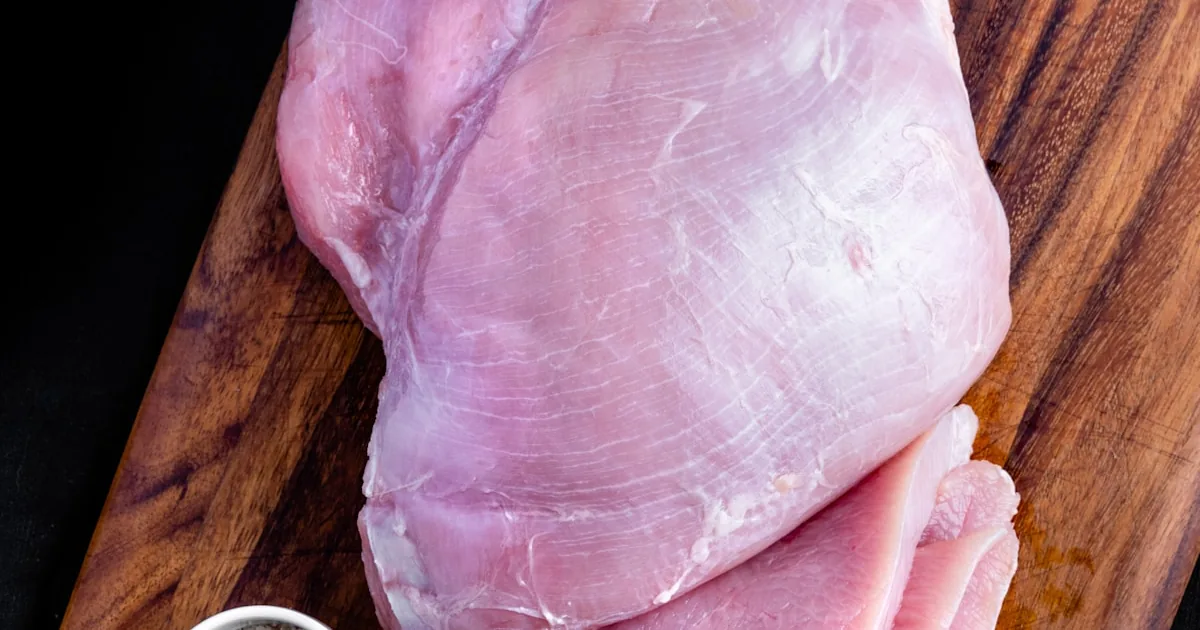
You weigh 200 grams of chicken before cooking. After grilling, the same chicken weighs only 150 grams.
Did 50 grams of chicken disappear? Did you lose calories? And when you enter it into your food-tracking app, should you log 200 grams or 150 grams?
Now consider rice. You measure 100 grams of dry rice, boil it, and end up with nearly 300 grams of cooked rice. The portion is heavier, but you haven't added three times the calories.
This is where food tracking gets confusing.
The simplest rule is to match the way you weigh your food with the way it's described in your nutrition database. If you weigh chicken raw, use a raw chicken entry. If you weigh rice cooked, use a cooked rice entry.
But there's more to understand, especially when cooking changes water content, fat content, or portion weight.
This guide explains how to weigh meat, rice, pasta, and other common foods accurately, with practical examples, formulas, and tips you can use in your own kitchen.
Should You Weigh Food Raw or Cooked?
Both methods can work. The most important thing is consistency and using the correct nutrition information.
For many home-cooked meals, weighing ingredients before cooking is convenient and can make tracking more reliable because you know exactly how much of each ingredient went into the dish.
However, weighing cooked food is perfectly reasonable when you're serving leftovers, eating food prepared by someone else, or portioning a batch of meals.
Here's how to choose:
Situation | Recommended Method |
Cooking chicken at home | Weigh raw; log a matching raw entry |
Preparing dry rice | Weigh dry; log dry rice |
Cooking pasta | Weigh dry; log dry pasta |
Eating leftover chicken | Weigh cooked; log matching cooked chicken |
Serving cooked rice | Weigh cooked; log cooked rice |
Making several meal-prep portions | Track ingredients, then divide the finished recipe |
Eating restaurant food | Use restaurant information or a suitable prepared-food estimate |
One mistake causes many tracking problems: weighing a cooked food but logging it using a raw-food entry.
That can produce a significantly inaccurate estimate.
Why Do Calories Per 100 Grams Change After Cooking?
Cooking changes the weight of food, mostly because of water.
Different foods behave differently:
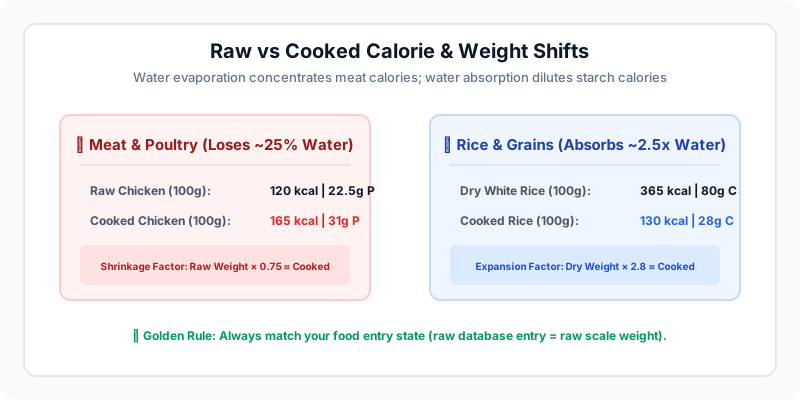
- Meat usually loses water as it cooks, making it lighter.
- Rice absorbs water and becomes heavier.
- Pasta absorbs water and expands.
- Vegetables may lose or gain water depending on the cooking method.
Water contributes weight but no calories.
That means the same food can have very different calorie values per 100 grams before and after cooking.
Example: Chicken Breast
Imagine you start with 200 g of raw chicken breast containing approximately 240 calories, based on an illustrative raw-food value of 120 calories per 100 g.
After grilling, it weighs 150 g.
If only water were lost, the calories in the remaining chicken would still be approximately 240.
Those same calories would now be concentrated in a smaller amount of food.
However, real cooking can also cause some fat and nutrient losses into juices or drippings. That's why this example is an approximation, not an exact measurement.
Example: White Rice
Now imagine you cook 100 g of dry white rice containing approximately 365 calories.
After boiling, it weighs 280 g.
Most of the added weight is water.
If nothing calorie-containing was added or discarded, the batch still contains approximately 365 calories.
Per 100 g cooked:
365 ÷ 280 × 100 = approximately 130 calories.
The rice didn't gain or lose substantial energy simply because it absorbed water. Its calories became spread across a larger weight.
Key takeaway: Cooking often changes calorie density much more than it changes the total energy in the original ingredients.
Raw vs Cooked Calories: Quick Comparison Table
These reference values illustrate why using the correct food state matters.
Food | Food State | Approximate Calories per 100 g |
Skinless chicken breast | Raw | 120 kcal |
Chicken breast, meat only | Roasted | 165 kcal |
White long-grain rice | Dry | 365 kcal |
White long-grain rice | Cooked | 130 kcal |
Regular pasta | Dry | 371 kcal |
Regular pasta | Cooked | 158 kcal |
The chicken and rice examples correspond to specific USDA food descriptions. Pasta values are representative database examples. They should not be treated as universal values for every product or cooking method.
Chicken cuts, moisture levels, cooking methods, pasta ingredients, and rice varieties can change the results.
The most reliable approach is to use the nutrition record matching your actual food.
How to Weigh Chicken Breast for Accurate Calories
Chicken breast is one of the foods people most frequently weigh when tracking protein and calories.
Unfortunately, it's also easy to log incorrectly.
Method 1: Weigh Chicken Before Cooking
This is a convenient option when preparing chicken yourself.
Follow these steps:
- Place a clean container on your kitchen scale.
- Press the tare button to reset the displayed weight to zero.
- Add the raw chicken breast.
- Record its weight.
- Select a nutrition entry describing the same raw cut, including whether it has skin or bones.
- Cook the chicken and separately account for any added oil, butter, marinade, or sauce.
Example:
You weigh 250 g of raw, boneless, skinless chicken breast.
Using an illustrative raw value of 120 calories per 100 g:
250 × 120 ÷ 100 = 300 calories.
You would record approximately 300 calories for the raw chicken ingredient using that database entry.
The actual finished dish may differ because of cooking losses and additions.
Method 2: Weigh Chicken After Cooking
Suppose someone else grilled chicken and you only have the finished portion.
You weigh it and get 150 g.
If the appropriate cooked-chicken database entry lists 165 calories per 100 g:
150 × 165 ÷ 100 = 247.5 calories.
You can record approximately 248 calories.
The important detail is that you used a cooked chicken entry for the cooked weight.
Don't take that 150 g cooked portion and multiply it by a raw-chicken calorie value.
Why Do Some Chicken Entries Show Different Calories?
You might see different calorie values for:
- Raw chicken breast
- Roasted chicken breast
- Grilled chicken breast
- Chicken breast with skin
- Fried chicken breast
- Breaded chicken
These are not necessarily interchangeable.
Removing skin changes fat content. Breading adds ingredients. Frying can add absorbed oil. Cooking method and moisture loss also affect calories per 100 g.
Practical advice: Choose the most specific database description available, rather than selecting whichever chicken entry appears first.
For more information on chicken protein and nutrients, visit our Chicken Breast Nutrition Guide.
How to Weigh Rice: Dry vs Cooked Calories
Rice can be especially confusing because it often becomes roughly two to three times heavier during cooking, depending on the variety and water absorption.
Let's use a practical example.
If You Weigh Rice Before Cooking
You measure 100 g of uncooked white rice.
Your nutrition database shows approximately 365 calories per 100 g.
You cook it in plain water.
After cooking, the entire batch weighs 280 g.
Assuming no meaningful calorie-containing ingredients were added or lost, the batch contains approximately 365 calories.
Now suppose you eat 140 g of the cooked rice.
That's half the cooked batch.
Your estimated calories are:
365 × 140 ÷ 280 = 182.5 calories.
So your portion contains approximately 183 calories.
If You Weigh Rice After Cooking
You serve yourself 150 g of cooked white rice.
Your cooked-rice database entry shows 130 calories per 100 g.
Calculate:
150 × 130 ÷ 100 = 195 calories.
That's the calorie estimate for your portion using that cooked entry.
Is 100 g of Raw Rice the Same as 100 g of Cooked Rice?
No.
One hundred grams of dry rice contains much less water and considerably more energy per gram.
One hundred grams of cooked rice includes a large amount of absorbed water.
That's why dry rice typically contains significantly more calories per 100 g than cooked rice.
What If You Add Oil or Butter?
Then the total calories change.
For example, cooking 100 g of dry rice with 10 g of oil adds approximately 90 calories if all the oil remains in the prepared food.
The original 365-calorie rice batch would then contain approximately:
365 + 90 = 455 calories.
If the finished batch weighs 290 g and you eat 145 g, you consume half of the prepared batch, or approximately 228 calories.
Remember that cooking additions must be included to estimate a dish accurately.
How to Weigh Pasta: Dry or Cooked?
Pasta behaves similarly to rice.
When you boil dry pasta, it absorbs water and becomes heavier.
The exact increase depends on the pasta shape, ingredients, and cooking time.
Example: Cooking 100 g of Dry Pasta
Suppose 100 g of dry pasta provides 371 calories.
After boiling and draining, your pasta weighs 235 g.
For this example, assume the pasta retains approximately the same calories.
The cooked calorie density becomes:
371 ÷ 235 × 100 = approximately 158 calories per 100 g.
Now suppose you eat 150 g of the cooked pasta.
150 × 371 ÷ 235 = approximately 237 calories.
That's the estimated energy in your cooked portion before adding sauce, cheese, oil, or other ingredients.
Why Is the Pasta Package Different From Your Calorie App?
Pasta packages commonly provide nutritional information for a dry serving.
A food database may display values for cooked pasta.
If a pasta package lists 200 calories for 55 g dry pasta, those numbers should not automatically be applied to 55 g of cooked pasta.
For the best result, weigh the dry pasta and use the package information, or select a matching cooked entry when weighing the finished pasta.
Does Overcooking Pasta Add Calories?
Cooking pasta longer can increase the amount of water it absorbs.
That changes the weight and calories per 100 g.
However, water itself adds no energy.
Some starch and other solids may move into the cooking water and be discarded, so exact calorie retention isn't always perfect.
The essential point remains: a heavier portion after boiling doesn't mean the pasta gained calories from water.
Raw-to-Cooked Weight Calculator: How to Convert Portions
If you want to track a cooked meal using the raw ingredients you measured, you can use a simple ratio.
Cooked portion's share of the batch = Cooked portion weight ÷ Total cooked batch weight
Then:
Estimated portion calories = Total batch calories × Cooked portion's share
This method works particularly well for a batch of rice or pasta when cooking additions and any meaningful losses are accounted for.
Use our interactive calculator below to quickly calculate your cooked portion's exact share and calories based on raw vs cooked batch weights.
How to Track Calories When Meal Prepping
Meal prepping makes calorie tracking easier once you establish a consistent routine. When cooking multiple meals in advance, follow our Meal Prep Safety & Storage Guide to keep your prepared portions fresh and safe throughout the week.
Suppose you're preparing four portions of chicken, rice, and vegetables.
Step 1: Weigh and Record Each Ingredient
Imagine your recipe contains:
Ingredient | Raw Amount | Illustrative Calories |
Chicken breast | 600 g | 720 |
Dry white rice | 200 g | 730 |
Mixed vegetables | 400 g | 120 |
Olive oil | 20 g | 180 |
Total | 1,750 |
These values are illustrative. Use the actual nutrition data for your ingredients.
Step 2: Cook the Meal
Prepare the ingredients using your preferred method.
You do not need to assume that cooked chicken weighs exactly 75% of its raw weight or that rice always triples in weight.
Cooking yields vary.
Step 3: Divide Into Four Equal Portions
If the ingredients' calculated total is 1,750 calories and you divide everything evenly into four portions:
1,750 ÷ 4 = 437.5 calories per portion.
This is a recipe-based estimate that assumes all counted calories remain in the finished food.
If you discard cooking fat, remove bones, or drain substantial calorie-containing liquid, account for those changes where possible.
What If the Meal-Prep Containers Have Different Weights?
If the fully mixed finished recipe weighs 1,600 g, you can calculate its estimated calories per gram:
1,750 ÷ 1,600 = 1.09375 calories per gram.
A 350 g portion would contain approximately:
350 × 1.09375 = 383 calories.
This proportional approach works best when every portion contains roughly the same combination of ingredients.
If one container contains extra chicken and another contains more rice, calculate those components separately.
Do You Need to Weigh Every Ingredient?
Not necessarily.
A kitchen scale is useful when you want precise portions, need consistent recipes, or are learning what different amounts of food look like.
But food weighing isn't essential for everyone.
You can also use household measures, package serving information, or reasonable estimates when precision isn't necessary.
If you're tracking intake for a particular medical condition, work with a qualified professional on the level of detail appropriate for your needs.
The purpose of weighing food should be to make your routine easier and more informative, not more stressful.
Seven Common Raw vs Cooked Calorie Tracking Mistakes
1. Weighing Cooked Chicken but Logging Raw Chicken
A 150 g grilled portion isn't nutritionally equivalent to 150 g of the raw version simply because the weights match.
Better approach: Use a cooked database entry for a cooked weight.
2. Using Dry Rice Calories for Cooked Rice
Dry rice is much more calorie-dense per 100 g than rice prepared with water.
Better approach: Match dry weight to dry nutrition or cooked weight to cooked nutrition.
3. Forgetting Added Cooking Oil
Oil contributes calories even if the ingredients themselves are relatively low in energy.
Better approach: Measure oil used in cooking and consider how much remains in the food.
4. Assuming Cooking Changes Only Water
Meat may lose fat and other nutrients through drippings. Boiling can also transfer some nutrients into discarded water.
Better approach: Use suitable cooked-food values or recipe yield information rather than assuming perfect nutrient retention.
5. Using One Conversion Factor for Every Food
Chicken, beef, rice, pasta, and vegetables change weight differently.
Better approach: Weigh your finished batch when possible.
6. Logging a Database Entry Without Reading Its Description
An entry may describe raw chicken with skin, roasted chicken without skin, or breaded chicken.
Better approach: Read the full food description, including preparation method and edible portion.
7. Double-Counting Recipe Ingredients
If you calculate a complete dish's calories from its raw ingredients, you shouldn't add the same cooked ingredients again as separate entries.
Better approach: Choose one consistent approach for each recipe.
Interactive Raw-to-Cooked Portions Calculator
Instantly convert scale weights between raw and cooked states with estimated macros.
Estimates based on USDA FoodData Central average yield retention factors. Actual yields may vary slightly by cook time, cut, and heat intensity.
Frequently Asked Questions
Should I weigh chicken raw or cooked for calories?
Either method can work. Weigh raw chicken when using a raw chicken nutrition entry, or weigh cooked chicken when using an appropriate cooked entry. Raw weighing is often convenient when preparing recipes yourself.
Does chicken lose calories when cooked?
Chicken generally loses weight during cooking because moisture evaporates. Some fat and nutrients may also be lost in cooking juices or drippings. As a result, the total calorie content can change, but the increase in calories per 100 g of cooked chicken is mainly related to reduced water weight.
Is 100 g of cooked rice the same as 100 g of uncooked rice?
No. Uncooked rice contains much less water, so 100 g dry rice generally contains substantially more calories than 100 g cooked rice.
How many grams of cooked rice come from 100 g dry rice?
A practical example might yield around 250–300 g of cooked rice from 100 g dry rice, but the actual result depends on rice variety, cooking method, and water absorption. Weigh your cooked batch for a more accurate conversion.
Does pasta have fewer calories after cooking?
Cooked pasta generally has fewer calories per 100 g because it contains more water. The total energy from the dry pasta remains approximately similar when boiled in plain water, although some food solids may be lost into discarded cooking water.
Should I log pasta dry or cooked?
If you weigh pasta before boiling, use dry pasta nutrition information. If you weigh it after cooking, select a cooked pasta entry or calculate the portion from your measured dry batch.
How do I calculate calories in a cooked meal?
Calculate the calories of the ingredients, include cooking additions, account for meaningful discarded fat or other losses where possible, and divide the finished recipe into portions. A food scale can help determine each portion's share.
Should I weigh frozen food before or after cooking?
Follow the state specified in the nutrition information. For example, if the package values describe the frozen product as sold, use the corresponding weight unless its instructions say otherwise. Added sauces, oil, or breading must also be considered.
Are calories lost when you boil vegetables?
Cooking can change the nutrient content of vegetables, and some water-soluble nutrients may move into cooking water. However, most non-starchy vegetables are relatively low in calories, so small portion-measurement differences may have limited impact on total energy intake.
Why do two calorie-tracking apps show different values for the same food?
Entries may refer to different varieties, cuts, brands, preparation methods, or serving sizes. User-submitted data may also contain errors. Prefer verified manufacturer information and reputable food composition databases.
Final Thoughts: Raw or Cooked Doesn't Matter as Much as Matching the Data
You don't need a complicated system to track your food accurately.
If you're preparing a meal yourself, weighing ingredients before cooking is often a straightforward choice.
If you're eating leftovers or serving already-cooked food, weighing it after cooking can work just as well. When dining out at restaurants where you cannot weigh foods beforehand, apply the visual portion methods in our Restaurant Calorie Estimation Guide.
Remember three simple principles:
- Match the food's measured state to its nutrition entry.
- Account for ingredients added or removed during cooking.
- Use your actual cooked batch weight when dividing homemade recipes.
Rice and pasta become heavier as they absorb water. Meat often becomes lighter as it loses moisture. Neither change means calories are created or destroyed simply by water moving in or out.
Once you understand that difference, food tracking becomes much easier.
And the next time your 200 g chicken breast weighs only 150 g after grilling, you'll know exactly why the number on your kitchen scale changed—and how to choose the right entry.