How many calories should you eat per day?
There is no single calorie number that is right for everyone.
Your daily calorie needs depend on factors such as your age, sex, height, weight, activity level, metabolism, and whether your goal is to maintain, lose, or gain weight. NIDDK specifically notes that calorie needs vary with factors including age, weight, height, metabolism, sex, and physical activity.
As a broad reference, long-used U.S. Estimated Energy Requirement tables place many adult women around 1,600 to 2,400 calories per day and many adult men around 2,000 to 3,000 calories per day, depending largely on age and activity. These are population-level estimates, not personal prescriptions.
A smaller, older, sedentary person may need considerably fewer calories than a younger, taller, highly active person.
This guide explains what calories are, how many you may need, what changes your calorie requirements, and how to adjust your food intake for maintenance, weight loss, or weight gain.
Quick Answer: How Many Calories Should I Eat a Day?
For many adults, estimated daily calorie needs fall somewhere within these broad ranges:
Group | Broad Daily Calorie Range |
Adult women | About 1,600–2,400 calories |
Adult men | About 2,000–3,000 calories |
These ranges are only starting points.
Your personal calorie needs may be higher or lower depending on:
- Age
- Height
- Body weight
- Sex
- Physical activity
- Muscle mass
- Daily movement
- Health status
- Pregnancy or breastfeeding
- Whether you want to maintain, lose, or gain weight
The most useful question is therefore not:
“How many calories should everyone eat?”
It is:
“Approximately how many calories does my body need for my current size, activity, and goal?”
What Is a Calorie?
A calorie is a unit of energy.
Food and beverages provide energy your body uses for everything from keeping your heart beating to walking, exercising, thinking, digesting food, and maintaining body temperature.
Calories come primarily from:
- Carbohydrates
- Protein
- Fat
- Alcohol
Your body needs energy even when you are sleeping or resting.
That means you burn calories throughout the entire day, not only when you exercise.
Is 2,000 Calories a Day Right for Everyone?
No.
The 2,000-calorie diet you often see on Nutrition Facts labels is a general reference for nutrition labeling, not a universal recommendation.
The FDA states that 2,000 calories per day is used as a general guide for nutrition advice, while individual calorie needs may be higher or lower depending on age, sex, height, weight, and physical activity.
One person may maintain their weight on 1,800 calories.
Another might need 2,400.
A highly active person may require 3,000 calories or considerably more.
So do not assume you should eat exactly 2,000 calories simply because that number appears on food labels.
What Determines How Many Calories You Need?
Several factors influence daily calorie requirements.
1. Age
Calorie needs often change as you get older.
Younger people may need more energy because of growth, activity, and higher energy expenditure.
For many adults, energy requirements gradually decrease with age, especially if muscle mass and physical activity decline.
That does not mean every older adult should automatically eat very little. Individual body size, activity, health, and nutritional needs still matter.
2. Sex
On average, males often have higher estimated calorie requirements than females because they tend to have differences in body size and lean body mass.
However, sex alone does not determine calorie needs.
A highly active woman may require more energy than a smaller sedentary man.
3. Height
Larger bodies generally require more energy to maintain than smaller bodies.
A person who is 190 cm tall will often require more calories than someone who is 155 cm tall, assuming other factors are similar.
4. Body Weight
Your body uses energy to maintain living tissue.
As body size increases, maintenance energy requirements generally increase as well.
This is one reason two people with the same height and activity level may have different calorie needs if their body weights differ.
5. Physical Activity
Activity can have a major effect on daily energy expenditure.
Someone who works at a desk and does little exercise may require significantly fewer calories than someone who:
- Walks many kilometers per day
- Works a physical job
- Runs regularly
- Cycles
- Swims
- Plays sports
- Performs frequent resistance training
NIDDK notes that adults who are more physically active generally need more calories than adults who are less active.
6. Muscle Mass
Lean tissue requires energy.

People with more muscle often have somewhat higher resting energy requirements than people of the same body weight with less lean mass.
However, muscle is only one part of the equation.
Total body size, activity, age, sex, and genetics also matter.
7. Daily Movement
Exercise is not the only activity that burns calories.
Your body also uses energy when you:
- Walk around the house
- Clean
- Shop
- Stand
- Take stairs
- Work
- Carry groceries
- Play with children
- Move throughout the day
Two people who perform the same 30-minute workout may still have very different total daily energy expenditure because one moves much more during the rest of the day.
8. Pregnancy and Breastfeeding
Pregnancy and breastfeeding change nutritional and energy needs.
Calorie requirements are not simply a matter of “eating for two,” and needs vary by pregnancy stage, body size, health, and other factors.
Pregnant or breastfeeding individuals should use guidance tailored to their situation rather than relying on a general online calorie target.
9. Your Goal
The amount of food you eat may also depend on whether your goal is to:
- Maintain weight
- Lose weight
- Gain weight
- Support athletic performance
- Build muscle
Understanding your maintenance calories is usually the starting point.
What Are Maintenance Calories?
Maintenance calories are approximately the number of calories you need to eat to keep your body weight relatively stable over time.
If you consume about the same amount of energy your body uses:
Calories eaten ≈ Calories used
your body weight will generally remain around the same level, although normal daily fluctuations still occur.
For example:
If someone uses roughly 2,300 calories per day, then approximately 2,300 calories would represent their estimated maintenance intake.
But remember: this is an estimate.
Your body does not operate like a perfectly calibrated machine.
What Is TDEE?
TDEE stands for Total Daily Energy Expenditure.
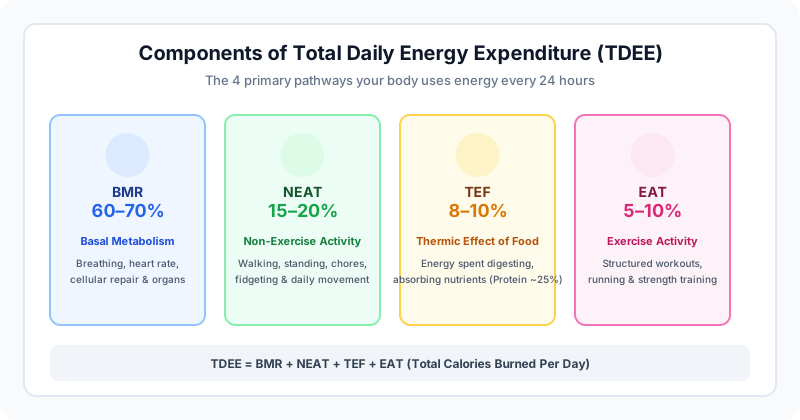
It represents the total amount of energy your body uses in a day.
TDEE includes several components.
Basal Metabolic Rate
Your Basal Metabolic Rate, or BMR, represents the energy required for essential body functions at rest.
These include:
- Breathing
- Circulation
- Organ function
- Cell maintenance
- Body-temperature regulation
Even if you stayed in bed all day, your body would still require energy.
Physical Activity
Exercise increases energy expenditure.
Examples include:
- Walking
- Running
- Cycling
- Swimming
- Strength training
- Sports
Everyday Movement
Activities outside formal exercise also contribute to daily calorie expenditure.
Walking to your car, cleaning your home, standing at work, and taking stairs all require energy.
Digestion
Your body also uses some energy to digest, absorb, and process the food you eat.
All these components contribute to your total daily energy expenditure.
BMR vs TDEE: What Is the Difference?
These terms are often confused.
BMR estimates the energy your body needs for essential functions at rest.
TDEE estimates your entire day's energy expenditure, including physical activity and normal movement.
For deciding approximately how many calories you need to eat each day, TDEE is generally more useful than BMR.
You usually should not treat your BMR as your normal daily calorie target because you do more than simply remain completely at rest.
How Do You Calculate Daily Calorie Needs?
The easiest method is to use an evidence-based calorie or TDEE calculator.
A calculator typically asks for information such as:
- Age
- Sex
- Height
- Weight
- Activity level
It then estimates your daily energy expenditure.
For more personalized weight-change planning, NIDDK provides a Body Weight Planner designed for adults to estimate calorie and physical-activity changes associated with reaching and maintaining a goal weight. NIDDK notes that the tool is intended for adults, not children or pregnant or breastfeeding people.
Remember that calculators provide estimates, not exact measurements.
Your real-world body-weight trend can help you refine that estimate over time.
Daily Calorie Needs by Activity Level
Activity can substantially change how much energy you require.

A useful way to think about activity is:
Sedentary
A mostly sedentary lifestyle might include:
- Desk-based work
- Limited walking
- Little structured exercise
A person in this category will generally require fewer calories than a similar-sized active person.
Moderately Active
A moderately active lifestyle may include regular walking and several exercise sessions during the week.
Energy requirements increase because the body is doing more work.
Active
An active individual may:
- Walk considerable distances daily
- Exercise frequently
- Work a physical job
- Participate in sports
- Perform demanding training
An active person may need hundreds of additional calories compared with a similar sedentary person.
This is one reason copying another person's calorie target is rarely useful.
How Many Calories Do Women Need Per Day?
There is no single correct number for all women.
Older U.S. federal Estimated Energy Requirement tables place many adult women in a broad range of approximately 1,600 to 2,400 calories per day, depending mainly on age and physical activity.
For example, calorie requirements tend to be lower for someone who is:
- Smaller
- Older
- Less physically active
and higher for someone who is:
- Taller
- Heavier
- Younger
- More physically active
Pregnancy and breastfeeding also change nutritional requirements and should be handled separately.
The 1,600–2,400 figure is therefore a population-level reference, not a target every woman should follow.
How Many Calories Do Men Need Per Day?
Again, needs vary widely.
Federal Estimated Energy Requirement tables have historically placed many adult men within approximately 2,000 to 3,000 calories per day, depending on age and activity.
A sedentary older man may be near the lower end.
A young, physically active man may be closer to the upper end or may require more depending on body size and training volume.
The correct number is personal rather than universal.
How Many Calories Should You Eat to Maintain Weight?
To maintain your current weight, your average calorie intake generally needs to approximate your average calorie expenditure.
For example:
Estimated TDEE: 2,400 calories
Estimated maintenance intake: around 2,400 calories per day
You do not need to consume exactly 2,400 calories every single day.
You might eat:
- 2,300 one day
- 2,500 another
- 2,400 the next
Your longer-term average matters more than perfectly matching a number each day.
How Many Calories Should You Eat to Lose Weight?
Weight loss requires an overall energy deficit.
That means your average energy intake needs to be lower than your average energy expenditure over time.
For example:
Estimated maintenance: 2,300 calories
Planned intake: 2,000 calories
Estimated deficit: 300 calories per day
However, the appropriate calorie reduction depends on the individual.
You should not automatically subtract a very large number from your maintenance calories just because you want faster results.
A more moderate approach is usually easier to sustain and makes it easier to obtain adequate nutrients.
For a detailed explanation of this process, see our guide to What Is a Calorie Deficit?
How Many Calories Should You Eat to Gain Weight?
Weight gain generally requires consuming more energy than your body uses over time.
For example:
Estimated maintenance: 2,400 calories
Intake: 2,650 calories
Estimated surplus: 250 calories
If your goal is to gain muscle rather than simply increase scale weight, your overall plan should also include:
- Sufficient protein
- Resistance training
- Adequate carbohydrates
- Healthy fats
- Recovery
- Enough sleep
A very large calorie surplus is not automatically better.
Your body can only build muscle at a limited rate, so dramatically overeating does not guarantee dramatically faster muscle growth.
Do You Need to Count Calories?
No.
Calorie counting can be useful, but it is not mandatory.
CDC notes that counting calories all the time is not necessary, although knowing approximately how many calories you need can help with weight management.
Some people benefit from tracking because it helps them understand:
- Portion sizes
- Calorie-dense foods
- Liquid calories
- Snacking habits
- Restaurant portions
- Their typical daily intake
Other people prefer a less numerical approach.
For example, you can focus on:
- Eating mostly nutrient-dense foods
- Including protein at meals
- Eating vegetables regularly
- Choosing whole fruit
- Selecting whole grains
- Adjusting portions
- Limiting frequent high-calorie drinks
The best method is the one you can use without becoming unnecessarily obsessive about food.
How Accurate Are Calorie Calculators?
Calorie calculators are useful starting points, but they cannot know your exact energy expenditure.
Even good equations are estimates.
Two people with identical:
- Age
- Height
- Weight
- Sex
may still burn different amounts of energy because of differences in:
- Daily movement
- Body composition
- Exercise
- Genetics
- Metabolism
- Work activity
Use the calculator as a starting point.
Then observe your real-world trend.
For example, if a calculator estimates your maintenance intake at 2,300 calories and your weight remains fairly stable around that intake for several weeks, the estimate may be reasonably close.
If your weight consistently changes, your real maintenance level may be different.
Why Does Your Calorie Requirement Change?
Your daily calorie requirements are not permanently fixed.
They can change when your:
- Body weight changes
- Activity increases or decreases
- Exercise routine changes
- Age changes
- Muscle mass changes
- Job becomes more or less physical
- Health changes
For example, someone training for a long-distance event may require more calories during intense training than during a period of little exercise.
Likewise, someone who loses a significant amount of body weight may eventually require fewer calories to maintain the smaller body.
Do Calories Matter More Than Food Quality?
Both matter, but they answer different questions.
Calories describe energy.
Food quality describes much more, including:
- Protein
- Fiber
- Vitamins
- Minerals
- Essential fats
- Degree of processing
- Overall nutritional value
Two meals may contain the same number of calories while providing very different nutrients and levels of fullness.
For example:
A meal containing fish, potatoes, vegetables, and fruit may provide a very different nutritional profile from the same number of calories coming mainly from sweets and sugary drinks.
The current Dietary Guidelines for Americans, 2025–2030 emphasize diets built around nutrient-dense foods including protein foods, dairy, vegetables, fruits, healthy fats, and whole grains, while reducing highly processed foods.
So calorie intake matters, but the quality of those calories matters too.
What Should You Eat Within Your Daily Calorie Target?
Rather than trying to fill your calorie allowance with random foods, build your diet around nutritious staples.
Protein-Rich Foods
Examples include:
- Eggs
- Fish
- Chicken
- Lean meats
- Greek yogurt
- Cottage cheese
- Beans
- Lentils
- Tofu
- Edamame
Vegetables
Eat a variety such as:
- Broccoli
- Spinach
- Carrots
- Tomatoes
- Bell peppers
- Mushrooms
- Cauliflower
- Leafy greens
Fruit
Examples include:
Carbohydrate Sources
Options include:
- Oats
- Potatoes
- Rice
- Quinoa
- Whole-grain bread
- Beans
- Whole grains
Healthy Fat Sources
Examples include:
- Nuts
- Seeds
- Avocado
- Olive oil
- Fatty fish
CDC likewise recommends staying within daily calorie needs while building the diet from nutritious foods rather than eliminating entire categories such as carbohydrates.
Simple Balanced Daily Meal Example
Your portions should depend on your personal needs, but a normal day might look like this:

Breakfast
Eggs + whole-grain toast + fruit
You could also use:
Greek yogurt + oats + berries
Lunch
Chicken + rice + vegetables
Add a modest amount of healthy fat such as olive oil or avocado if desired.
Snack
Greek yogurt + fruit
or:
Apple + nuts
Dinner
Fish + potatoes + mixed vegetables
This type of structure supplies more than calories alone.
It provides protein, carbohydrates, fiber, vegetables, fruit, fats, vitamins, and minerals.
What Are Empty Calories?
People sometimes use the phrase “empty calories” to describe foods that supply considerable energy while providing relatively few useful nutrients.
Examples may include frequent large amounts of:
- Sugary soft drinks
- Candy
- Certain desserts
- Alcohol
- Highly processed snack foods
This does not mean you can never eat a dessert or drink something sweet.
Your overall dietary pattern matters.
But when much of your daily energy comes from foods with limited nutritional value, it can become harder to meet nutrient needs within your calorie allowance.
Why Portion Size Matters
Even nutritious foods can provide more calories than you expect when portions become large.
Examples include:
- Nuts
- Nut butter
- Olive oil
- Avocado
- Cheese
- Granola
- Seeds
These foods can absolutely fit into a healthy diet.
But “healthy” does not mean “calorie-free.”
The current nutrition evidence base continues to emphasize matching portions and overall dietary intake to energy requirements.
How to Read Calories on a Nutrition Facts Label
Nutrition labels can help you understand how much energy a packaged food provides.
Start by checking:
Serving Size
Calories usually correspond to the serving size listed.
If the package contains four servings and you eat the entire package, you may consume four times the calories listed per serving.
The FDA specifically notes that the number of servings you actually consume determines your total calorie and nutrient intake.
Calories Per Serving
Look at the calorie number.
Then compare it with the amount you actually plan to eat.
Nutritional Value
Do not stop at calories.
Also consider:
- Protein
- Fiber
- Added sugars
- Sodium
- Saturated fat
- Vitamins and minerals
Calories tell you how much energy a food provides, not whether it is nutritionally complete.
Can You Eat Carbohydrates Within Your Daily Calories?
Yes.
Carbohydrates are not automatically a problem.
Nutritious carbohydrate-containing foods include:
- Oats
- Rice
- Potatoes
- Beans
- Whole grains
- Fruit
- Whole-grain bread
Your total dietary pattern and calorie intake matter more than simply labeling one macronutrient as responsible for weight change.
Can You Eat Fat Every Day?
Yes.
Dietary fat is necessary for health.
Useful sources include:
- Olive oil
- Nuts
- Seeds
- Avocado
- Fish
Because fat is energy-dense, portions can have a noticeable effect on daily calorie intake.
You do not need to avoid healthy fats.
Simply include them in amounts appropriate for your total energy needs.
Does Protein Have Calories?
Yes.
Protein provides energy as well as essential amino acids.
Protein-rich foods can include:
- Eggs
- Poultry
- Fish
- Dairy
- Beans
- Lentils
- Soy foods
Protein is important, but eating unlimited protein does not make calories irrelevant.
Your entire diet still contributes to total energy intake.
Why You Should Not Copy Someone Else's Calorie Target
You may see someone online eating 1,500, 1,800, 2,500, or 3,000 calories per day.
That tells you almost nothing about what you should eat.
Their:
- Height may be different
- Weight may be different
- Age may be different
- Sex may be different
- Activity may be different
- Goal may be different
- Training may be different
A calorie intake that creates weight loss for one person could maintain weight for another person and be too low for someone else.
Use your own estimated needs.
Common Mistakes When Estimating Daily Calories
Assuming Everyone Needs 2,000 Calories
The 2,000-calorie figure on food labels is a reference value.
It is not a personalized prescription.
Using BMR as Your Daily Calorie Target
Your BMR only represents a portion of your total energy expenditure.
Your normal daily activity requires additional energy.
Overestimating Activity Level
Someone who exercises three times per week but spends most of the day sitting may not have the same energy requirements as someone performing physical work every day.
Choose your activity level realistically.
Believing Fitness Trackers Are Exact
Smartwatches and exercise machines can be useful for tracking trends, but calorie-burn numbers should be treated as estimates.
Making Huge Calorie Changes Immediately
If your estimated maintenance calories are 2,300, dropping suddenly to an extremely low intake is not automatically a better strategy.
Nutrition and sustainability still matter.
Ignoring Drinks
Calories can come from beverages such as:
- Soft drinks
- Specialty coffees
- Juice
- Milkshakes
- Alcohol
They count toward your total intake just like calories from food.
Focusing Only on Calories
A diet can technically fit a calorie target while still being poor in:
- Protein
- Fiber
- Vitamins
- Minerals
- Fruits
- Vegetables
Calorie control should not replace nutrition quality.
Who Should Avoid Setting Their Own Restrictive Calorie Target?
Generic online calorie advice may not be appropriate for everyone.
Seek individualized professional guidance if you:
- Are pregnant
- Are breastfeeding
- Are under 18
- Are underweight
- Have an eating disorder or history of disordered eating
- Have diabetes requiring medication
- Have kidney, liver, or other significant medical conditions
- Take medication that affects appetite or blood sugar
- Have unexplained weight loss or weight gain
NIDDK's adult Body Weight Planner, for example, specifically states that it is not intended for people younger than 18 or for pregnant or breastfeeding women.
Frequently Asked Questions
The Bottom Line
There is no single daily calorie number that is right for everyone.
Your calorie needs depend on:
- Age
- Sex
- Height
- Weight
- Activity
- Metabolism
- Body composition
- Health
- Your weight goal
Broad population estimates place many adult women around 1,600–2,400 calories per day and many adult men around 2,000–3,000 calories per day, but your personal requirement may be outside those ranges.
The best starting point is to estimate your Total Daily Energy Expenditure, then adjust your intake according to whether you want to maintain, lose, or gain weight.
But do not focus on the calorie number alone.
Build your diet around nutrient-dense foods such as protein sources, vegetables, fruits, healthy fats, dairy or suitable alternatives, and whole grains, consistent with the current Dietary Guidelines for Americans.
Calories tell you how much energy you eat.
Good nutrition determines what comes with that energy.
For most people, understanding both is more useful than chasing one “perfect” calorie number.