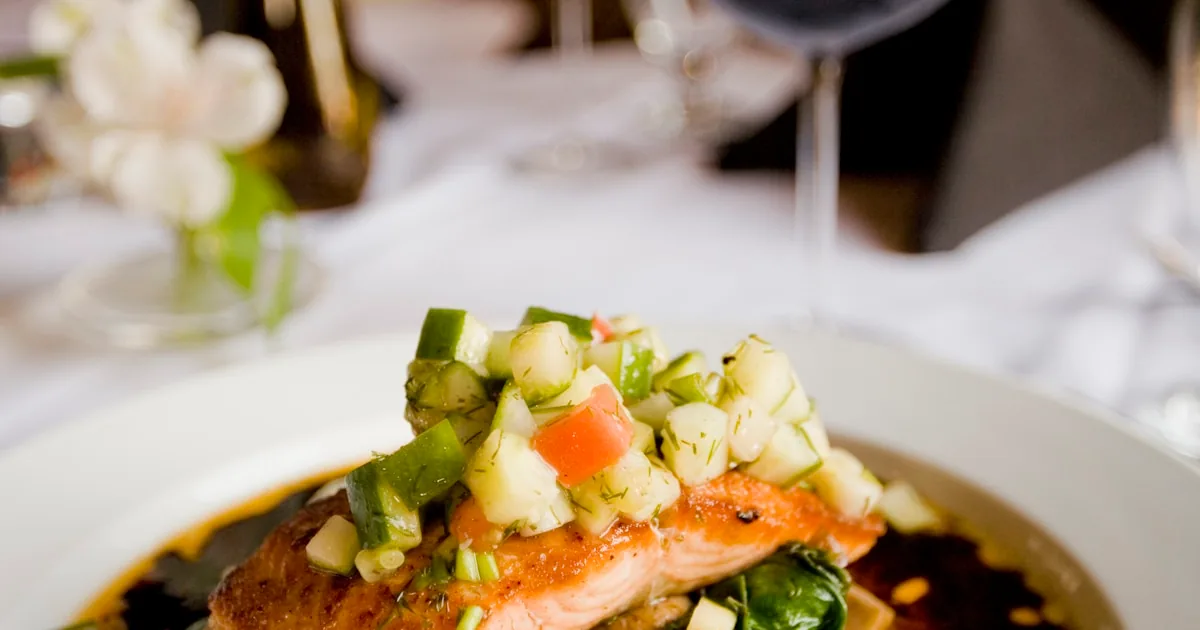
You order a grilled chicken plate at a local restaurant. It comes with rice, vegetables, a creamy sauce, and a piece of bread.
It looks like a balanced meal. But there's one problem: the restaurant doesn't provide calorie information.
How do you know whether you've eaten 500 calories, 800 calories, or considerably more?
You could search for a similar meal in a calorie-tracking app, but the results might vary widely. One entry may assume a small serving of rice and hardly any oil. Another may include a larger portion and several tablespoons of sauce.
The good news is that you can make a useful calorie estimate without knowing the restaurant's exact recipe.
The most practical approach is to break the meal into its main ingredients, estimate realistic portions, account for cooking fats and sauces, and calculate a reasonable total.
You'll still have some uncertainty. Restaurant portions, recipes, and cooking methods vary, and even careful estimates aren't exact measurements.
But you don't need perfect information to make an informed estimate. If you are managing your weight or following a fat loss phase, pair these estimation tactics with our Calorie Deficit Guide to accommodate social meals without stalling progress.
This guide shows you how to estimate restaurant calories step by step, using examples from chicken-and-rice plates, burgers, pizza, pasta, salads, and takeaway meals.
Quick Answer: How Do You Estimate Calories in Restaurant Food?
When a restaurant doesn't provide nutrition information, use these five steps:
- Look for official calorie information first. Check the restaurant's website, app, printed menu, or other available nutrition materials.
- Break the meal into parts. Identify the protein, rice or bread, vegetables, cooking fats, sauces, toppings, and drinks.
- Estimate the portion size. Use visual references or the closest available serving description.
- Find matching food entries. Use reputable nutrition databases and select cooked or prepared foods that resemble your meal.
- Add the estimates together. Include cooking oil, butter, dressings, and other ingredients that may not be obvious.
For example, a chicken-and-rice plate might contain:
Meal Component | Illustrative Calories |
Grilled chicken | 250 |
Cooked rice | 260 |
Cooked vegetables | 60 |
Cooking oil | 90 |
Creamy sauce | 120 |
Estimated meal total | 780 |
These are hypothetical component values, not verified nutrition information for a restaurant.
Your own plate may contain different quantities and ingredients.
The goal is to build a reasonable estimate using the food you actually received.
Step 1: Check Whether the Restaurant Already Provides Nutrition Information
Before estimating anything, check whether the restaurant publishes its nutritional information.
You may find it on:
- The official restaurant website
- An online ordering menu
- The restaurant's mobile app
- A printable nutrition guide
- The in-store menu or menu board
- Written information available from staff
In the United States, certain chain restaurants with 20 or more locations are generally required to provide calorie information for standard menu items. Covered establishments must also make additional written nutrition information available on request.
However, independent restaurants, smaller chains, and some menu items may not be covered by those federal requirements.
Rules outside the United States can differ.
What if the restaurant gives a calorie range?
Some menu items come with choices of sides, flavors, or ingredients.
For example, a menu may show:
Chicken sandwich combo: 650–950 calories
The lower and higher values may represent different combinations.
If you choose the larger side, extra sauce, and a calorie-containing drink, your meal may fall toward the higher end.
When possible, ask which choices are included in the listed values.
Should you trust calories from another restaurant?
Not automatically.
Two restaurants can serve dishes with the same name but very different recipes.
A grilled chicken sandwich might differ in:
- Bread size
- Chicken weight
- Oil used during cooking
- Type and amount of sauce
- Cheese and other toppings
- Side dishes
Nutrition information from another restaurant can be a useful reference, but it isn't proof that your meal contains the same calories.
Best practice: Use exact restaurant information when available. Otherwise, treat similar menu items as estimates and adjust for visible differences.
Step 2: Break the Restaurant Meal Into Individual Components
This is one of the most useful techniques for estimating calories without nutrition facts.
Rather than searching for a single generic entry such as "restaurant chicken meal," identify what is actually on the plate.
Consider this example:
You order a grilled chicken rice bowl with vegetables and garlic sauce.
Instead of recording it as one unknown item, separate it into:
Protein: Grilled chicken breast
Carbohydrate: Cooked white rice
Vegetables: Broccoli, carrots, or other vegetables
Cooking fat: Oil or butter used in preparation
Sauce: Garlic sauce, mayonnaise-based dressing, or another condiment
Extras: Cheese, nuts, seeds, or additional toppings
Once you separate these ingredients, the calculation becomes easier.
You can find representative nutrition values for each component rather than relying on a potentially inaccurate generic meal entry.
Why does this work?
Imagine two chicken rice bowls.
Both contain chicken, rice, and vegetables.
But the first is prepared with a small amount of oil and a light sauce.
The second contains generous oil, a mayonnaise-based dressing, and extra cheese.
They look similar at first glance, but their calorie totals could be substantially different.
Breaking the meal into components helps you recognize those differences.
Step 3: Estimate Restaurant Portion Sizes Without a Food Scale
You probably don't bring a kitchen scale to a restaurant.
That's perfectly reasonable.
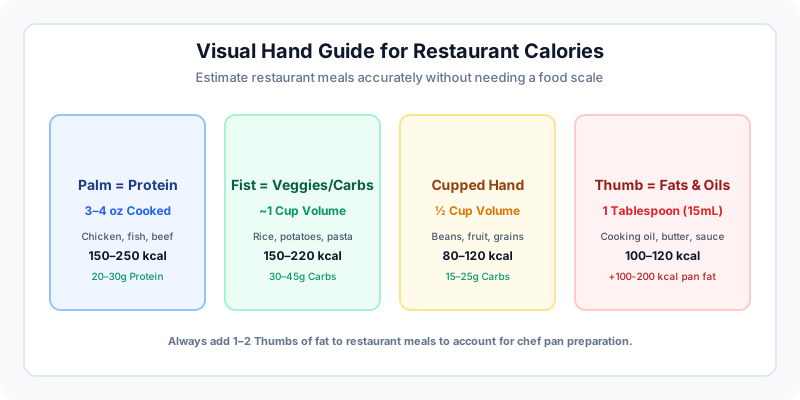
Visual portion references can help you make a rough estimate when exact weights aren't available.
The following comparisons are starting points, not precise measurements.
Food | Practical Visual Reference | What to Remember |
Cooked meat or fish | Palm-sized portion | Thickness and shape affect weight |
Cooked rice or pasta | Fist-sized portion | Bowl size and packing density vary |
Cheese | A small pair of dice | Different cheeses have different densities |
Cooking oil | A measured teaspoon or tablespoon | Much of it may be mixed into the food |
Sauce or dressing | Small condiment cup | Cups vary widely in size |
Vegetables | A fist or cupped hands | Cooking and oil change calorie content |
Estimating Chicken
Suppose your plate contains a piece of chicken roughly the size of your palm.
That gives you a rough visual reference, but it doesn't confirm the chicken's weight.
A thick piece of chicken can weigh considerably more than a thin one with the same surface area.
For a better estimate, compare it with cooked chicken portions you've weighed at home.
Over time, you'll become more familiar with what different amounts look like.
Estimating Rice
A large restaurant scoop of rice may contain much more than you expect.
If you're unsure, think about the amount of cooked rice you would normally serve in a measuring cup or bowl at home.
Was the restaurant portion similar, twice as large, or somewhere in between?
Use that comparison to choose a suitable cooked-rice database entry.
Estimating Pasta
Pasta is particularly difficult to judge by appearance because different shapes occupy different volumes.
A plate of spaghetti, penne, or fettuccine may look similar in size but contain different weights.
Creamy sauces, cheese, and cooking fats also affect calories.
Whenever possible, estimate the pasta and sauce separately.
Useful takeaway: Visual references are useful for consistency, but they shouldn't be treated as exact conversions from hand size to grams.
Step 4: Estimate the Calories From Each Ingredient
Once you've identified the ingredients and their approximate portions, calculate the meal.
Use this formula:
Estimated meal calories = Protein + Starch + Vegetables + Cooking fats + Sauces + Extras
Let's work through a realistic example.
Example: Restaurant Chicken and Rice Plate
You order:
- A grilled chicken breast
- A generous serving of white rice
- A side of cooked vegetables
- Garlic sauce
- Some cooking oil
After comparing the portions with suitable nutrition references, you choose the following illustrative values:
Component | Estimated Calories |
Grilled chicken breast | 280 |
Cooked white rice | 300 |
Cooked vegetables | 50 |
Cooking oil | 90 |
Garlic sauce | 140 |
Total | 860 |
Your estimated meal contains approximately 860 calories.
This doesn't mean the exact restaurant meal contains 860 calories.
It means that, based on your chosen ingredient portions and assumptions, 860 calories is a working estimate.
If the sauce is mayonnaise-based or the rice contains substantial butter, the actual amount could be higher.
If the portions are smaller or the preparation uses less fat, it could be lower.
What if you only eat half?
If you eat approximately half of a reasonably uniform dish, you can estimate half its total calories.
860 ÷ 2 = 430 calories.
But there's an important limitation.
If you eat all the chicken and sauce while leaving most of the rice, you haven't necessarily eaten half the calories just because half the food remains on the plate.
For dishes with separate components, estimate what you actually consumed.
Step 5: Don't Forget Cooking Oil, Butter, and Sauces
One of the biggest sources of uncertainty in restaurant calorie estimates is hidden fat.
Oil and butter can be used in:
- Grilling and sautéing
- Frying
- Cooking rice
- Preparing vegetables
- Making sauces
- Toasting sandwich buns
- Finishing dishes before serving
Fat provides approximately 9 calories per gram.
For example, a hypothetical 10 g of cooking oil contributes approximately 90 calories.
If a dish contains 20 g of added oil, that's approximately 180 calories from the oil alone.
However, not all oil used during cooking necessarily ends up in the finished food.
Some may remain in the pan or be discarded.
How much oil should you assume?
There is no accurate universal amount.
A restaurant might use very little oil for one dish and considerably more for another.
Rather than automatically adding a tablespoon of oil to every restaurant meal, consider:
- How the dish was cooked
- Whether the food appears coated in oil
- Whether oil or butter is visible on the plate
- Whether the sauce is creamy or oil-based
- Whether cooking fat is already included in the database entry
Important: If you use a prepared-food entry that already accounts for cooking oil, don't add that same oil again.
Sauces Can Make a Big Difference
Consider a restaurant salad with grilled chicken, vegetables, and dressing.
The salad ingredients may be relatively straightforward to estimate.
But dressing can change the total substantially.
A light vinaigrette, a creamy ranch dressing, and a rich cheese-based dressing can have very different energy contents.
Instead of assuming all sauces are equal, search for the closest matching sauce and estimate the portion you used.
A useful restaurant habit is to request sauce on the side when available. That makes the amount easier to judge without requiring you to avoid sauce entirely.
Step 6: How to Estimate Calories in Common Restaurant Meals
Different types of meals require slightly different approaches.
The best method is not to assume every meal of a particular type has a standard calorie value.
Instead, identify the ingredients that are most likely to make a meaningful difference.
How to Estimate Burger Calories
A burger can be divided into:
- Bun
- Beef, chicken, or plant-based patty
- Cheese
- Mayonnaise or other sauces
- Vegetables
- Additional toppings
For example:
Burger Component | Illustrative Calories |
Burger bun | 200 |
Cooked beef patty | 300 |
Cheese slice | 80 |
Sauce | 100 |
Vegetables | 20 |
Estimated burger | 700 |
These are hypothetical values. Actual burger calories depend on patty size, fat content, bread, toppings, and preparation.
If you add fries and a drink, estimate those separately.
Don't log an entire burger meal as just the burger.
How to Estimate Pizza Calories
For pizza, consider:
- Pizza diameter
- Crust thickness
- Number of slices
- Cheese quantity
- Meat or vegetable toppings
- Stuffed crust or extra sauces
If a nutrition database entry closely matches your pizza style and serving size, you can use it as a starting point.
But avoid assuming every slice has the same calories.
A thin-crust cheese slice and a large, deep-dish meat pizza slice are not nutritionally equivalent.
How to Estimate Pasta Calories
Separate the pasta from the sauce and toppings.
A plate of plain tomato-sauce pasta may differ significantly from one made with cream, butter, cheese, and chicken.
For a more accurate estimate, identify:
- Pasta portion
- Sauce type and quantity
- Cheese
- Meat or seafood
- Cooking oil or butter
Make sure you select cooked pasta values if you're estimating the amount served on the plate.
For more information, see our Raw vs Cooked Food Calories Guide.
How to Estimate Salad Calories
A salad doesn't automatically have fewer calories than other restaurant meals.
Its calorie content depends on what is added.
Consider:
- Leafy vegetables
- Grilled or fried protein
- Cheese
- Croutons
- Nuts and seeds
- Avocado
- Dressing
A substantial salad with nuts, cheese, chicken, and dressing can be a satisfying, nutrient-rich meal.
The best approach is to estimate the components rather than assuming the word "salad" means low calorie.
How to Estimate Calories in Takeaway Rice Dishes
Fried rice, biryani, pilaf, and other restaurant rice dishes can be difficult to estimate because cooking fats and ingredients are mixed throughout the food.
For these dishes:
- Find the closest prepared-dish entry.
- Estimate how much of the dish you ate.
- Check whether the entry includes oil, meat, vegetables, and other ingredients.
- Adjust your estimate if the restaurant's preparation appears substantially different.
- Avoid adding ingredients separately if they're already included in the prepared-dish entry.
A plain cooked-rice entry is generally not a suitable substitute for a richly prepared rice dish.
Step 7: Find Reliable Calorie Information for Similar Foods
When official restaurant nutrition information is unavailable, look for the closest reliable food reference.
A useful starting point is USDA FoodData Central, which provides nutrient information for many raw, cooked, and prepared foods.
Search using descriptive food terms instead of only a broad meal name.
For example:
Instead of searching "chicken," search for a preparation that matches your dish, such as roasted chicken breast without skin.
Instead of searching "rice," specify cooked white rice, cooked brown rice, or an appropriate prepared rice dish.
Instead of searching "pasta," look for cooked pasta with the relevant sauce, or estimate the components separately.
Which Nutrition Database Entry Should You Choose?
Ask yourself:
- Is the food raw or cooked?
- Does it contain skin, bones, or breading?
- Is it baked, grilled, fried, or roasted?
- Does the entry include sauce?
- Is the portion size realistic?
- Is the source identifiable and credible?
If several entries differ substantially, investigate why.
Don't automatically choose the lowest or highest calorie entry.
Choose the one that most closely resembles your meal.
Step 8: Use a Calorie Range When You're Unsure
Restaurant calorie estimates are rarely exact when ingredients and quantities are unknown.
A practical way to handle that uncertainty is to create low, middle, and high scenarios based on plausible ingredient amounts.
Example: Chicken Rice Bowl
Imagine you make these estimates:
Component | Lower Scenario | Higher Scenario |
Chicken | 220 | 320 |
Rice | 200 | 350 |
Vegetables | 30 | 80 |
Oil | 40 | 180 |
Sauce | 60 | 200 |
Total | 550 | 1,130 |
This gives you an illustrative working range of 550–1,130 calories.
The range is broad because there is substantial uncertainty about portions, cooking oil, and sauce.
It is not a scientifically validated confidence interval.
If you can narrow down the amount of rice, identify the sauce, or obtain preparation details, your range may become more useful.
Should You Log the Middle of the Range?
For casual food tracking, a reasonable central estimate can be practical when there's no better information.
In the example above, the midpoint is:
(550 + 1,130) ÷ 2 = 840 calories.
But 840 isn't automatically the most likely value.
A midpoint treats the lower and higher scenarios symmetrically, even though your actual meal may be closer to one end.
If you have stronger evidence about ingredient quantities, use that evidence rather than blindly selecting the middle.
And if you occasionally can't estimate a meal reliably, it's fine to record an approximate meal description instead of forcing an exact number.
Step 9: How to Track Restaurant Meals Without Overthinking
You don't need to turn every meal out into a mathematical exercise.
For most people, a simple routine works best.
Before ordering: Check for official nutrition information if it's readily available.
When the meal arrives: Look at the main ingredients and approximate portions.
While eating: Notice whether you use all the sauce, finish the sides, or leave some food.
After eating: Record a reasonable estimate using matching entries.
For future visits: Save the estimate if you regularly order the same meal from the same restaurant.
If the portion or recipe changes, update the estimate.
What If You Ate More Than Expected?
You don't need to respond by skipping meals or trying to compensate aggressively through exercise.
One meal doesn't determine your overall health or nutritional progress.
If you're tracking intake, record the best estimate you can and return to your normal eating routine.
Consistency and useful information matter more than false precision.
Common Mistakes When Estimating Restaurant Calories
Mistake 1: Choosing the First Entry in a Calorie App
User-submitted entries can be incomplete or inaccurate.
Better approach: Select a source with an identifiable food description and realistic serving size.
Mistake 2: Forgetting Side Dishes
Fries, bread, dipping sauces, and beverages can contribute to total meal calories.
Better approach: Consider the entire order, not only the main dish.
Mistake 3: Assuming "Grilled" Means No Added Fat
Grilled foods may still contain oil, butter, or calorie-containing marinades.
Better approach: Consider the actual preparation.
Mistake 4: Using Raw Food Values for Cooked Portions
Cooking changes water content and therefore calorie density.
Better approach: Match the food's cooked or raw state to the database description.
Mistake 5: Counting Cooking Oil Twice
Some prepared-food entries already include cooking fat.
Better approach: Check what the entry represents before adding separate ingredients.
Mistake 6: Treating an Estimate as an Exact Measurement
A restaurant meal cannot be measured accurately from appearance alone.
Better approach: Record reasonable uncertainty when portion sizes and ingredients are unknown.
Mistake 7: Ignoring What You Actually Ate
The portion served may be different from the portion consumed.
Better approach: Adjust your estimate for leftovers and uneaten components.
Restaurant Hand-Portion Calorie Estimator
Quickly estimate unlisted dining calories by counting visual hand portions on your plate.
Frequently Asked Questions
How can I calculate restaurant calories without a nutrition label?
Break the meal into ingredients, estimate portion sizes, find suitable food entries in a reputable nutrition database, and add the estimated calories. Include sauces, oils, toppings, sides, and drinks where relevant.
How accurate are restaurant calorie estimates?
Accuracy varies widely. Estimates may be reasonably useful when ingredients and portions are familiar, but uncertainty increases with hidden oils, complex sauces, mixed dishes, and unknown preparation methods. A visual estimate cannot guarantee a particular accuracy percentage.
How many calories are in an average restaurant meal?
There isn't one reliable number that applies to all restaurant meals. A small soup, large pizza, grilled fish plate, and creamy pasta dish can differ substantially. Estimating the actual meal or using official menu data is more useful than relying on a universal average.
How do I count restaurant calories when trying to lose weight?
Use the same practical method: check official information, estimate portions, include meaningful additions, and log a reasonable estimate if tracking is helpful to you. Avoid attempting to compensate harshly for meals that are difficult to measure.
How do I estimate calories in a restaurant buffet?
Estimate each plate separately. Identify the portions of proteins, starches, vegetables, sauces, and desserts you choose. If you return for additional servings, include them in your overall estimate.
How many calories should I add for restaurant cooking oil?
There's no universal number. The amount depends on the dish, cooking method, and how much oil remains in the food. Use a plausible oil estimate only when it isn't already accounted for in the food entry.
Does restaurant grilled chicken have the same calories as homemade chicken?
Not necessarily. Portion size, cooking fat, marinades, cuts of meat, and preparation methods can all differ. Homemade chicken nutrition may be a useful starting point, but it doesn't guarantee an exact match.
Can I estimate restaurant calories from a photo?
A photo may help identify visible foods and compare portion sizes, especially when there's a reference object. However, it cannot reliably reveal hidden fats, precise weights, or recipe ingredients. Treat photo-based calorie estimates as approximate.
Should I choose the highest calorie estimate to be safe?
Not automatically. Habitually choosing the highest possible estimate can create misleading records. Choose the most evidence-based estimate you can, and acknowledge uncertainty instead of assuming the worst-case scenario.
Is calorie tracking necessary to eat healthy at restaurants?
No. Calorie tracking can be useful for some people, but it isn't required for a nutritious eating pattern. Portion awareness, food variety, satisfaction, and overall dietary habits can also guide choices.
Final Thoughts: Aim for a Useful Estimate, Not a Perfect Number
You can enjoy restaurant meals even when their exact calorie information isn't available.
The most useful skill is learning to recognize what's in your food.
Start by identifying the main ingredients. Estimate realistic portions. Consider cooking fats, sauces, and sides. Then use trustworthy nutrition information to calculate a reasonable total.
Sometimes your estimate will be fairly straightforward.
Other times, especially with rich sauces, fried foods, or mixed dishes, the uncertainty will be much greater.
That's normal.
A calorie estimate is a tool to help you understand your food—not a number you need to get exactly right every time.
With practice, you'll find it easier to recognize portions, compare menu choices, and make decisions that fit your preferences and nutritional goals.