You drink a cup of coffee with breakfast, grab an iced tea at lunch, and open an energy drink when the afternoon slump hits.
None of those drinks seems unusual. But have you ever added up how much caffeine you've consumed?
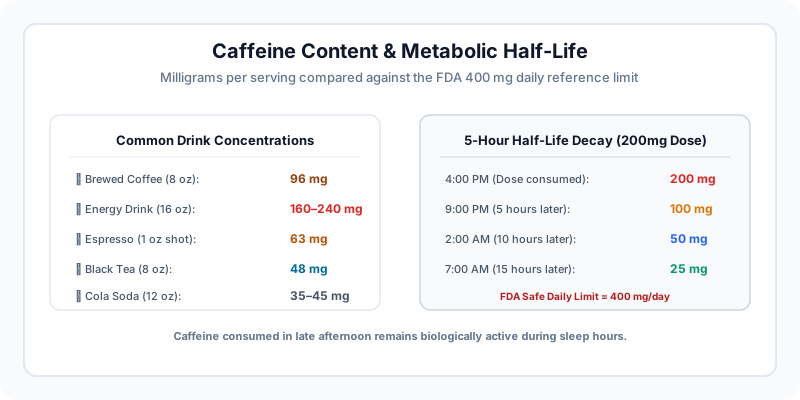
A regular 8-ounce cup of brewed coffee contains approximately 96 mg of caffeine, while a single espresso shot contains around 63 mg. An 8-ounce cup of black tea averages about 48 mg, and some energy drinks contain considerably more caffeine than a typical cup of coffee.
The surprising part? A larger coffee doesn't necessarily contain less caffeine than an energy drink. And a drink labeled "decaf" isn't always completely caffeine-free.
Knowing how much caffeine is in your favorite drinks can help you compare products, understand your daily intake, and recognize when caffeine may be affecting your sleep or making you feel jittery.
This guide covers coffee, black and green tea, energy drinks, soda, and other unexpected caffeine sources, with practical charts and examples.
How Much Caffeine Is in Coffee, Tea, Energy Drinks and Soda?
Here's a quick caffeine comparison using approximate values for common drinks.
Drink | Serving Size | Approximate Caffeine |
Brewed coffee | 8 fl oz (237 mL) | 96 mg |
Espresso | 1 fl oz (30 mL) | 63 mg |
Instant coffee | 8 fl oz (237 mL) | 62 mg |
Decaf brewed coffee | 8 fl oz (237 mL) | 1–2 mg in some reference examples |
Black tea | 8 fl oz (237 mL) | 48 mg |
Green tea | 8 fl oz (237 mL) | 29 mg |
Bottled black tea | 8 fl oz (237 mL) | 26 mg |
Regular cola | 12 fl oz (355 mL) | About 35–45 mg |
Typical energy drink | 8 fl oz (237 mL) | About 70–100 mg |
Energy drink, larger can | 16 fl oz (473 mL) | Highly variable; often around 160 mg, but some contain much more |
The values are general references based on Mayo Clinic and MedlinePlus data, not guarantees for every brand or preparation.
Important: Serving size matters. A 16-ounce coffee may provide approximately twice the caffeine of an 8-ounce coffee made at the same concentration.
Some coffee-shop drinks, cold brews, and concentrated energy products contain substantially more caffeine than the examples above.
For the most accurate estimate, check the manufacturer's published caffeine information.
1. How Much Caffeine Is in a Cup of Coffee?
Coffee is one of the most common dietary sources of caffeine.
But the amount in your cup depends on much more than whether it's labeled strong or mild.
Caffeine content can vary according to:
- Coffee bean variety
- Amount of ground coffee
- Brewing method
- Water-to-coffee ratio
- Drink size
- Whether the beverage contains regular or decaffeinated coffee
Brewed Coffee: Approximately 96 mg per 8 Ounces
According to Mayo Clinic's reference chart, an 8-ounce serving of brewed coffee contains about 96 mg caffeine.
That makes a useful starting point, but many mugs and takeaway coffees are considerably larger.
For illustration, if your coffee has that same concentration:
Coffee Size | Estimated Caffeine |
8 oz | 96 mg |
12 oz | 144 mg |
16 oz | 192 mg |
20 oz | 240 mg |
These larger-size numbers are mathematical examples, not measured amounts for particular coffee-shop drinks.
Actual coffee-shop caffeine values can vary substantially.
Practical tip: Don't assume one cup always means eight ounces. Measure your favorite mug once or check the cup size before estimating caffeine.
How Much Caffeine Is in Espresso?
A single 1-ounce espresso shot contains approximately 63 mg caffeine in Mayo Clinic's reference example.
That's less total caffeine than a standard 8-ounce brewed coffee, although espresso is much more concentrated.
A double espresso made with two equivalent shots would contain approximately 126 mg.
However, actual espresso caffeine varies with shot size, coffee quantity, and preparation.
Is Espresso Stronger Than Regular Coffee?
It depends on what you mean by stronger.
Per ounce: Espresso generally contains much more caffeine.
Per typical serving: A regular cup of brewed coffee may contain more caffeine than a single espresso shot because it's a larger drink.
For example:
- One espresso shot: approximately 63 mg
- One 8-ounce brewed coffee: approximately 96 mg
So if you're trying to compare caffeine intake, look at total milligrams per serving, not just how concentrated the drink tastes.
How Much Caffeine Is in Instant Coffee?
Instant coffee commonly contains less caffeine than brewed coffee in comparable servings, although this varies by product and preparation.
Mayo Clinic lists approximately 62 mg for an 8-ounce serving.
If you use more instant coffee granules than the recommended amount, the caffeine total may be higher.
Does Decaf Coffee Have Caffeine?
Yes.
Decaffeinated coffee is not necessarily caffeine-free.
Some reference examples contain only 1–2 mg per 8-ounce serving, but actual decaf coffee can contain more depending on the product and preparation.
If you need to avoid caffeine for medical reasons, don't assume every decaf drink contains zero caffeine.
2. How Much Caffeine Is in Black Tea, Green Tea and Other Teas?
Tea typically contains less caffeine than coffee when compared by similar beverage volume, but the actual amount varies.
Tea caffeine levels depend on the leaves, processing, brewing time, water temperature, and quantity used.
Black Tea vs Green Tea
Tea | Typical Serving | Approximate Caffeine |
Brewed black tea | 8 oz | 48 mg |
Brewed green tea | 8 oz | 29 mg |
Bottled black tea | 8 oz | 26 mg |
Decaf black tea | 8 oz | About 2 mg in a reference example |
These values are from Mayo Clinic's caffeine comparison information.
Your actual cup may contain a different amount.
Does Green Tea Always Have Less Caffeine Than Black Tea?
Not always.
Green tea usually contains less caffeine than black tea in common reference comparisons, but individual products overlap.
A strong green tea prepared with a large amount of leaves may contain more caffeine than a lightly brewed black tea.
Brewing method matters.
How Much Caffeine Is in Matcha?
Matcha is made from finely powdered green tea leaves that you consume as part of the drink.
Because you consume the powder, its caffeine content can differ from ordinary steeped green tea.
The amount depends heavily on how many grams of matcha powder are used and the caffeine concentration of the product.
For example, a matcha latte made with one small scoop may contain significantly less caffeine than another prepared with several scoops.
Best way to estimate matcha caffeine: Check the product's caffeine information and the amount of powder used, rather than treating every matcha latte as equivalent.
Does Herbal Tea Have Caffeine?
Many herbal infusions, such as pure peppermint or chamomile, are naturally caffeine-free because they're not made from the tea plant (Camellia sinensis).
However, not every product marketed as herbal tea is caffeine-free.
Blends may include black tea, green tea, yerba mate, guarana, or other caffeine-containing ingredients.
Always check the ingredient list.
3. How Much Caffeine Is in Energy Drinks?
Energy drinks vary enormously in caffeine content.
Some contain an amount similar to a cup of coffee. Others contain several times more.
According to the FDA, caffeine content in 12-ounce energy drinks can range from approximately 41 mg to 246 mg, based on the beverage-category data it cites.
That range is a strong reminder that the words "energy drink" don't tell you the precise caffeine dose.
Energy Drink Size vs Caffeine
A useful illustrative comparison:
Energy Drink | Hypothetical Caffeine Concentration | Total Caffeine |
8 oz can | 10 mg per oz | 80 mg |
12 oz can | 10 mg per oz | 120 mg |
16 oz can | 10 mg per oz | 160 mg |
16 oz stronger formulation | 15 mg per oz | 240 mg |
These are calculation examples, not claims about particular brands.
Some drinks contain higher concentrations or different container sizes.
Are Energy Drinks Stronger Than Coffee?
Sometimes, but not always.
An 8-ounce energy drink containing 80 mg caffeine has less caffeine than an 8-ounce brewed coffee with approximately 96 mg.
But a large energy drink containing 240 mg has substantially more.
Similarly, a large café coffee may contain more caffeine than a smaller energy drink.
Compare the caffeine milligrams and serving size, not the product category.
What About Sugar-Free Energy Drinks?
Sugar-free does not mean caffeine-free.
Removing sugar doesn't automatically change the caffeine amount.
A sugar-free energy drink may contain the same caffeine as a regular version, depending on the formulation.
If you're comparing energy drinks, check both caffeine information and the Nutrition Facts label for added sugars, calories, and other ingredients.
For a deeper explanation of food labels, see our Guide to Reading Nutrition Facts Labels.
Are Energy Drinks Safe for Teenagers?
Major public-health and pediatric recommendations advise against energy drinks for children and adolescents.
Children and teenagers may be more vulnerable to adverse effects, especially from concentrated caffeine products and other stimulants.
The adult 400 mg daily reference should not be used as a target or permission for children.
4. How Much Caffeine Is in Soda?
Most caffeinated sodas contain less caffeine per typical serving than brewed coffee.
However, the amount varies between brands.
MedlinePlus lists approximately 35–45 mg caffeine in a standard 12-ounce can of cola.
That means two cans of cola could provide roughly 70–90 mg caffeine.
Soda Caffeine Comparison
Soda Type | General Caffeine Pattern |
Regular cola | Often around 35–45 mg per 12 oz |
Diet cola | Varies by brand; check manufacturer information |
Some citrus sodas | Caffeine-free |
Other citrus sodas | May contain added caffeine |
Most root beers | Usually caffeine-free, with exceptions |
Caffeine-free cola | Formulated without added caffeine |
Don't assume all clear sodas are caffeine-free or that all dark sodas contain caffeine.
The brand and formulation matter.
Does Diet Soda Have Less Caffeine?
Not necessarily.
Diet soda may contain less sugar or fewer calories, but its caffeine content is determined separately.
Some diet sodas contain more caffeine than their regular counterparts.
Always compare the specific product information.
5. Which Has More Caffeine: Coffee, Tea, Energy Drinks or Soda?
For ordinary servings, coffee often contains more caffeine than tea or cola, while energy drinks vary substantially.
Here is a useful visual comparison based on selected reference values.
Beverage | Reference Serving | Caffeine |
Brewed coffee | 8 oz | 96 mg |
Typical energy drink | 8 oz | 79 mg |
Single espresso | 1 oz | 63 mg |
Instant coffee | 8 oz | 62 mg |
Black tea | 8 oz | 48 mg |
Cola | 8 oz | 33 mg |
Green tea | 8 oz | 29 mg |
Notice the serving-size difference for espresso.
Comparing only the numbers without looking at ounces could give you the wrong impression.
And these reference values don't represent the highest possible caffeine contents.
A large specialty coffee or strong energy drink may contain considerably more.
6. How Much Caffeine Is Safe Per Day?
For most healthy adults, the FDA cites 400 mg caffeine per day as an amount not generally associated with negative effects.
That is a general reference, not a recommended amount everyone should try to consume.
You don't need to drink caffeine to be healthy.
Some people experience unpleasant effects at much smaller doses.
Sensitivity can depend on:
- Genetics
- Body size
- Medications
- Health conditions
- Habitual caffeine consumption
- Pregnancy
- Sleep patterns
What Does 400 mg Look Like?
Using approximate standard values:
Drinks Consumed | Estimated Total Caffeine |
One 8 oz brewed coffee | 96 mg |
Two 8 oz brewed coffees | 192 mg |
Three 8 oz brewed coffees | 288 mg |
Four 8 oz brewed coffees | 384 mg |
Two 8 oz coffees plus two black teas | 288 mg |
The important detail is that a standard 8-ounce serving is smaller than many coffee-shop drinks.
You might approach the same daily total with fewer large coffees.
What About 200 mg in One Serving?
The European Food Safety Authority (EFSA) concludes that single doses up to 200 mg generally do not raise safety concerns for healthy adults under the conditions it evaluated.
But this doesn't mean 200 mg is comfortable for everyone.
Someone who rarely consumes caffeine may experience jitters, anxiety, palpitations, or sleep disruption at substantially smaller amounts.
How Much Caffeine During Pregnancy?
The American College of Obstetricians and Gynecologists advises limiting caffeine intake to less than 200 mg per day during pregnancy.
That includes caffeine from:
- Coffee
- Tea
- Soda
- Chocolate
- Energy drinks
- Certain medications and supplements
People who are pregnant should discuss individual questions with their prenatal healthcare professional.
What About Breastfeeding?
Caffeine can pass into breast milk.
ACOG notes that moderate intake around 200 mg per day is unlikely to affect most babies, although newborns and premature infants may be more sensitive.
Discuss concerns with a healthcare professional, particularly if an infant appears unusually wakeful or irritable.
7. How to Calculate Your Total Daily Caffeine Intake
You may drink less coffee than your friends and still consume more caffeine overall because of other products.
Consider this hypothetical day:
Time | Beverage | Estimated Caffeine |
8:00 AM | 12 oz brewed coffee, estimated from a reference concentration | 144 mg |
11:00 AM | 8 oz black tea | 48 mg |
2:00 PM | Energy drink with a label stating 160 mg | 160 mg |
5:00 PM | 12 oz cola | 40 mg |
Daily total | 392 mg |
This person is close to the FDA's 400 mg daily reference for most healthy adults.
But the estimate depends on the actual coffee and energy drink.
A stronger coffee or differently formulated energy drink could put the total above 400 mg.
Simple Calculation
Daily caffeine = Caffeine from coffee + tea + energy drinks + soda + other sources
If a coffee shop lists 180 mg for your drink, use that value instead of the general 96 mg-per-8-ounce reference.
If you're tracking caffeine, keeping a short record of drinks for a typical day can be helpful.
You don't necessarily need to track every milligram indefinitely.
The main goal is to recognize your normal intake and adjust it if it affects how you feel.
8. How Long Does Caffeine Stay in Your Body?
Caffeine is absorbed into the bloodstream after consumption and can affect alertness, sleep, and other functions.
Its average elimination half-life in healthy adults is often described as approximately 4–6 hours, although it varies widely.
Half-life means the approximate time it takes your body to eliminate half of the caffeine present.
Example: Coffee at 4 PM
Suppose you consume 200 mg caffeine at 4 PM.
Using an illustrative five-hour half-life:
Time | Approximate Caffeine Remaining |
4 PM | 200 mg |
9 PM | 100 mg |
2 AM | 50 mg |
7 AM | 25 mg |
This simplified model assumes a constant half-life and doesn't account for absorption time or individual differences.
It shows why afternoon caffeine may still be relevant when you're trying to sleep.
How Late Is Too Late for Coffee?
There's no universal cutoff.
Some people can drink a small coffee in the afternoon and sleep comfortably.
Others find that even a morning dose affects them later.
EFSA notes that doses around 100 mg may affect sleep duration or patterns in some adults, especially when consumed near bedtime.
If caffeine appears to interfere with your sleep, try moving your last caffeinated drink earlier and reducing the total amount.
9. What Are the Signs of Too Much Caffeine?
Excess caffeine may cause:
- Jitters or shakiness
- Nervousness or anxiety
- Difficulty sleeping
- Headache
- Nausea or upset stomach
- Faster heartbeat or palpitations
- Increased urination
These effects vary by person and dose.
If caffeine regularly causes unpleasant symptoms, your personal comfortable intake may be much lower than the general adult reference.
Can Too Much Caffeine Be Dangerous?
Yes.
Large caffeine doses, especially from concentrated products or supplements, can cause serious adverse effects.
Severe symptoms may include dangerous heart rhythm abnormalities, significant vomiting, confusion, or seizures.
If someone develops serious symptoms after caffeine consumption, seek urgent medical care or contact a poison-control service.
Don't attempt to manage suspected severe caffeine toxicity simply by drinking water or waiting.
Important: Pure or highly concentrated caffeine powders and liquids can be especially dangerous because small measuring errors may result in large doses.
10. Does Caffeine Help With Workouts?
Caffeine can improve performance in some exercise settings, particularly endurance activities and certain high-intensity efforts.
However, more caffeine isn't automatically better.
Potential downsides include digestive discomfort, anxiety, elevated heart rate, and disturbed sleep.
Also remember that caffeine is not a substitute for adequate food, fluids, training, or rest.
Someone exercising in the evening may prefer avoiding caffeinated pre-workout products because sleep disruption could outweigh their perceived training benefit.
For broader advice about exercise fueling, see our What to Eat Before and After a Workout Guide.
11. What Foods and Products Contain Hidden Caffeine?
Coffee, tea, and energy drinks aren't the only sources.
Caffeine may also appear in:
- Chocolate
- Coffee-flavored desserts
- Certain protein bars
- Pre-workout products
- Some pain-relief medications
- Certain weight-management products
- Energy gummies and shots
- Yerba mate beverages
Not all of these products contain caffeine, and the amount varies.
Some ingredients, including guarana, can contribute caffeine even when consumers don't immediately recognize them as caffeine sources.
How to Check Caffeine on Labels
For packaged drinks, look for:
- Total caffeine in milligrams.
- The serving size.
- The number of servings per container.
- Other caffeine-containing ingredients.
- Manufacturer information if the amount isn't stated clearly.
In the United States, total caffeine content is not universally required as a specific milligram declaration on every conventional food or beverage label.
If the package doesn't give an amount, check the manufacturer's official website or contact the company.
12. How to Reduce Caffeine Without Giving Up Your Favorite Drinks
You don't necessarily have to stop drinking coffee or tea completely.
If you want to reduce caffeine intake, gradual changes may be easier than suddenly stopping.
Try these practical options:
Mix Regular and Decaf Coffee
If you usually brew your coffee at home, try combining regular and decaffeinated grounds.
This can reduce caffeine while keeping a familiar taste.
Actual caffeine content will depend on the mixture and brewing method.
Choose Smaller Servings
A smaller coffee generally contains less caffeine than a larger serving of the same brew.
Replace an Afternoon Coffee
If your second coffee affects your sleep, try decaf coffee, a caffeine-free herbal infusion, or refreshing plain water in the afternoon. For optimal hydration benchmarks based on body weight, see our Hydration & Daily Water Intake Guide.
Check Energy Drink Labels
If an energy drink contains 200 mg caffeine, drinking half the can would provide approximately 100 mg, assuming the caffeine is evenly distributed.
Keep the remainder stored according to the product's instructions.
Reduce Gradually
People who regularly consume caffeine may experience withdrawal symptoms when they suddenly stop.
These can include headache, fatigue, and irritability.
Reducing your intake gradually can make the transition more comfortable.
Daily Caffeine Intake & Half-Life Tracker
Add your beverages to calculate total daily caffeine and estimated remaining bloodstream caffeine at bedtime.
Frequently Asked Questions
How much caffeine is in a regular cup of coffee?
A typical 8-ounce brewed coffee contains approximately 96 mg caffeine according to Mayo Clinic reference data. Actual values vary with coffee type, preparation, and serving size.
How much caffeine is in one espresso shot?
A standard 1-ounce espresso shot contains approximately 63 mg caffeine in a common reference example. Double shots and different preparations may contain more.
Does tea have more caffeine than coffee?
Typically, brewed coffee has more caffeine than black or green tea when compared by similar serving volumes. However, strong teas and lightly brewed coffees may overlap.
How much caffeine is in green tea?
An 8-ounce cup of brewed green tea contains approximately 29 mg in Mayo Clinic's reference chart. Actual caffeine content varies.
Is 200 mg of caffeine a lot?
For many healthy adults, 200 mg falls within commonly evaluated single-dose safety guidance. However, it may cause unpleasant symptoms in people who are sensitive to caffeine. Pregnancy and certain medical conditions require additional caution.
Is 400 mg of caffeine safe?
The FDA cites 400 mg per day as a general amount not usually associated with adverse effects in most healthy adults. It is not a universal personal safety guarantee or a target to reach.
How much caffeine is in a 16-ounce energy drink?
It depends on the product. A 16-ounce drink could contain around 160 mg in some formulations, while others contain much more. Check the specific label.
Is decaf coffee completely caffeine-free?
No. Decaffeinated coffee generally contains much less caffeine than regular coffee, but small amounts may remain.
Does Coke have caffeine?
Regular cola beverages typically contain caffeine. Many standard 12-ounce colas contain approximately 35–45 mg, although the exact amount depends on the brand.
Does Sprite contain caffeine?
Standard Sprite is generally marketed as caffeine-free, but formulations can vary by market or product line. Check the manufacturer's information for the specific beverage.
Does caffeine dehydrate you?
Caffeine can increase urine production, particularly in some circumstances. However, ordinary caffeinated beverages also contribute fluid, and moderate habitual consumption doesn't automatically cause dehydration.
Can caffeine cause anxiety?
Yes. Caffeine can cause or worsen nervousness, jitteriness, and anxiety symptoms in some people, especially at higher doses or with greater sensitivity.
Is it okay to drink caffeine every day?
Many healthy adults tolerate moderate daily caffeine consumption. Whether it is appropriate depends on your amount, personal response, sleep, medications, and health conditions.
How do I know if I'm drinking too much caffeine?
Look at your total daily intake and whether you experience symptoms such as poor sleep, jitters, stomach upset, or palpitations. Individual tolerance varies, so symptoms matter even if you're below 400 mg.
Final Thoughts: Check the Milligrams, Not Just the Drink Name
When it comes to caffeine, the type of drink tells only part of the story.
Coffee often contains more caffeine than tea, but espresso is much more concentrated. Energy drinks vary considerably, and even soda can contribute to your daily total.
Serving size matters just as much as the beverage category.
For most healthy adults, staying within the FDA's general 400 mg daily reference is a useful consideration, but your own comfortable intake may be lower.
You don't need to avoid caffeine completely unless your circumstances require it.
Instead, pay attention to how much you consume, when you consume it, and how it affects your sleep and wellbeing.
The simplest habit is to check caffeine in milligrams, count every source, and choose amounts that work for your body.