You pick up a loaf of whole-wheat bread at the supermarket. The package says it's high in fiber and made with whole grains. But the ingredient list includes emulsifiers, preservatives, and ingredients you've never heard of.
Does that make it ultra-processed? And if it does, should you stop eating it?
Now think about plain yogurt, canned beans, frozen vegetables, breakfast cereal, and protein bars. All of them have been processed in some way, but they aren't necessarily in the same category.
That's where the confusion begins.
Ultra-processed foods are industrially formulated products, often made with ingredients and additives that aren't typically used in home cooking. But the degree of processing doesn't automatically tell you everything about a food's nutritional value.
Research has linked diets high in ultra-processed foods to several health concerns, including obesity, type 2 diabetes, and cardiovascular disease. Yet scientists are still investigating how much of these associations is explained by processing itself, differences in nutrient content, eating behavior, and other factors.
This guide explains what ultra-processed foods are, how the NOVA classification system works, which everyday foods fall into different categories, and what the research means for your grocery shopping.
What Are Ultra-Processed Foods?
Ultra-processed foods, often abbreviated as UPFs, are products classified in Group 4 of the NOVA food classification system.
They are typically industrial formulations that combine ingredients extracted from foods, modified food substances, and additives used to create particular flavors, textures, appearances, or shelf-life characteristics. To decode industrial ingredients and hidden sweeteners on product packaging, consult our Added Sugar & Food Additives Guide.
Common examples include:
- Many packaged snack cakes and cookies
- Soft drinks
- Some sweetened breakfast cereals
- Instant noodles with industrial seasoning formulations
- Many packaged chicken nuggets
- Certain processed meat products
- Some flavored yogurts
- Many commercial protein bars
- Some ready-to-heat meals
- Various mass-produced packaged breads
Not every packaged food is ultra-processed, and not every ultra-processed food has the same nutritional composition.
For example, plain frozen vegetables are processed through freezing but generally fall into NOVA Group 1.
A commercially formulated breakfast cereal may fall into Group 4, even if it contains added vitamins and minerals.
This is why understanding the classification system is more useful than judging a food by its packaging alone.
What Is the NOVA Food Classification System?
NOVA is a food classification framework developed by researchers in Brazil.
Instead of categorizing foods primarily by calories, protein, carbohydrates, or fat, NOVA focuses on the nature, extent, and purpose of food processing.
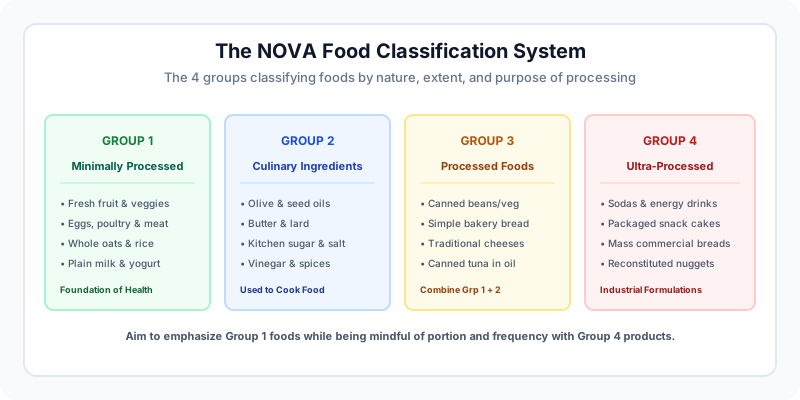
It separates foods into four groups.
NOVA Group | Classification | Common Examples |
Group 1 | Unprocessed or minimally processed foods | Fresh fruit, plain oats, eggs, plain milk, frozen vegetables |
Group 2 | Processed culinary ingredients | Sugar, salt, olive oil, butter |
Group 3 | Processed foods | Canned vegetables with salt, traditional cheese, simple freshly baked bread |
Group 4 | Ultra-processed foods | Soft drinks, many packaged snack foods, some industrial breads, instant meal products |
The main distinction isn't whether a food has been changed from its original form.
It's what processing has been done and what ingredients have been added.
Let's examine each category.
NOVA Group 1: Unprocessed or Minimally Processed Foods
These are foods that remain close to their original form, even if they've undergone processes needed for storage, safety, or preparation.
Examples include:
- Fresh apples and bananas
- Frozen berries without added ingredients
- Fresh or frozen vegetables
- Plain rolled oats
- Rice
- Dried lentils and beans
- Eggs
- Fresh meat or fish
- Plain pasteurized milk
- Plain unsweetened yogurt
- Unsalted nuts
Processing methods in this group may include washing, freezing, drying, pasteurizing, grinding, or removing inedible parts.
Is Frozen Food Ultra-Processed?
Not necessarily.
Frozen peas containing only peas are considered minimally processed.
They're frozen to preserve them, not formulated from industrial food substances and additives.
However, frozen peas in a heavily formulated cheese sauce could fall into a different NOVA group.
What matters is the complete product, not just the fact that it's frozen.
Is Plain Yogurt Processed?
Yes, yogurt is made through fermentation.
But plain unsweetened yogurt made from milk and cultures typically belongs to Group 1.
This is an important example of why processing isn't automatically harmful.
Processes such as pasteurization and fermentation can improve safety, preservation, and other food characteristics.
NOVA Group 2: Processed Culinary Ingredients
Group 2 includes substances extracted from foods or obtained from nature that people normally use when preparing meals.
Examples include:
- Olive oil
- Vegetable oil
- Butter
- Table salt
- Sugar
- Honey
These ingredients usually aren't eaten as complete meals on their own.
They're used to cook, season, or combine Group 1 foods.
Is Olive Oil Ultra-Processed?
Ordinary olive oil isn't classified as ultra-processed simply because it has been extracted from olives.
It belongs to NOVA Group 2.
The same general principle applies to common cooking ingredients such as salt and sugar.
However, being in Group 2 doesn't mean you should consume unlimited amounts.
Sugar and salt still matter nutritionally, and oils are energy-dense.
NOVA classification and nutritional recommendations answer different questions.
NOVA Group 3: Processed Foods
Group 3 generally includes foods made by adding Group 2 ingredients, such as salt, sugar, or oil, to Group 1 foods using relatively simple preservation or preparation methods.
Examples include:
- Some canned vegetables with added salt
- Canned fish in oil
- Traditional cheese
- Salted nuts
- Simple bread made from flour, water, yeast, and salt
- Certain pickled vegetables
These foods are processed, but not necessarily ultra-processed.
Are Canned Beans Ultra-Processed?
Usually not.
Plain canned beans containing beans, water, and salt are typically classified as processed foods.
Beans canned in water without added salt may qualify as minimally processed, depending on the specific product.
More complex products containing industrial flavorings, texturizers, or other characteristic Group 4 ingredients may be classified differently.
Is Cheese Ultra-Processed?
It depends on the product.
Traditional cheese made from milk, cultures, salt, and enzymes usually falls into Group 3.
Some processed cheese products made with additional industrial ingredients may fall into Group 4.
Don't assume every cheese product belongs to the same category.
NOVA Group 4: Ultra-Processed Foods
Group 4 includes industrial formulations often designed to be convenient, ready to eat, highly palatable, and shelf-stable.
They may contain ingredients such as:
- Protein isolates
- Modified starches
- Certain emulsifiers
- Flavorings
- Colorings
- Non-sugar sweeteners
- Other ingredients used to create specific sensory characteristics
However, the presence of a single unfamiliar ingredient doesn't always settle the classification.
Researchers assess the overall formulation and processing characteristics.
Common Ultra-Processed Food Examples
Food | Why It May Be Classified as Ultra-Processed |
Packaged snack cakes | Industrial formulations using refined ingredients and additives |
Regular soft drinks | Formulated sweetened beverages |
Many breakfast cereals | Industrial formulations with flavors, sweeteners, or other characteristic ingredients |
Commercial chicken nuggets | Often reconstituted or formulated with multiple industrial ingredients |
Instant noodles | Some contain characteristic industrial ingredients and formulated seasoning products |
Certain protein bars | May contain protein isolates, sweeteners, and texturizers |
Some flavored yogurts | May include industrial flavors, sweeteners, and other additives |
Mass-produced packaged bread | Some formulations contain emulsifiers and other characteristic ingredients |
Ready-to-eat desserts | Often contain industrially formulated components |
These are typical examples, not definitive classifications of every product in each category.
A specific recipe or ingredient list may lead to a different classification.
Processed vs Ultra-Processed Foods: What's the Real Difference?
Here's a simple comparison.
Imagine three types of bread:
Bread A: Flour, water, yeast, and salt, baked in a local bakery.
Bread B: A packaged loaf with flour, water, yeast, salt, and a small number of ordinary processing ingredients.
Bread C: A mass-produced loaf containing flour, protein isolates, emulsifiers, flavors, and other characteristic industrial formulation ingredients.
Bread A would generally fit Group 3.
Bread B requires checking its formulation; packaging alone isn't enough to classify it.
Bread C is more likely to meet NOVA's Group 4 criteria.
Does That Mean Bread C Is Always Less Nutritious?
Not automatically.
Bread C might contain more fiber or less sodium than another bread.
That's why using processing level as the only food-quality measure can be misleading.
A useful comparison considers:
- Processing classification
- Fiber content
- Whole-grain ingredients
- Added sugars
- Sodium
- Saturated fat
- Portion size
For practical nutrition decisions, check both the ingredient list and the Nutrition Facts panel.
How to Identify Ultra-Processed Foods From Ingredient Lists
You can often recognize a likely UPF by examining the ingredients, but there isn't a universally reliable shortcut that classifies every product.
Try this three-step approach.
Step 1: Identify the Basic Food
Ask yourself what the main food is.
Is it plain oats, milk, beans, or vegetables?
Or is it a formulated ready-to-eat product such as a snack bar or flavored dessert?
Step 2: Look at the Added Ingredients
Certain ingredients can signal a Group 4 formulation, particularly when they're used to create flavor, texture, or appearance.
Examples may include flavorings, some colorings, modified starches, and industrial protein isolates.
But ingredient context matters.
For example, plain ascorbic acid is vitamin C. Its chemical-sounding name alone doesn't prove a food is unhealthy or ultra-processed.
Step 3: Check the Nutrition Facts
Even when a food is classified as ultra-processed, examine its actual nutrients.
Look for:
- Dietary fiber
- Protein
- Added sugars
- Sodium
- Saturated fat
- Overall serving size
A food's processing category doesn't replace its nutritional information.
For help interpreting labels, read our How to Read Nutrition Facts Labels Guide.
What Does Scientific Research Say About Ultra-Processed Foods?
This is where the subject becomes more complicated.
Studies consistently report associations between higher ultra-processed food intake and several adverse health outcomes.
But different study designs can answer different questions.
Observational research can identify associations.
Randomized trials are better suited to studying causal effects under controlled conditions.
Understanding both types of evidence helps prevent exaggerated claims.
1. The 2024 BMJ Umbrella Review
A major umbrella review published in The BMJ in February 2024 examined existing meta-analyses involving nearly 9.9 million participants.
It reported associations between greater ultra-processed food exposure and numerous adverse health outcomes.
The review found direct associations with 32 of the 45 pooled health outcomes investigated.
These included cardiovascular, metabolic, mental health, and mortality-related outcomes.
However, the certainty of evidence varied considerably.
Of the 45 pooled analyses, only four were rated as moderate certainty using GRADE; most were rated low or very low.
What this tells us: The overall pattern is concerning, but the associations do not establish that processing itself caused every observed outcome.
2. The 2019 NIH Randomized Trial
A particularly important experiment was conducted by researchers at the U.S. National Institutes of Health.
Twenty adults participated in a controlled inpatient study comparing ultra-processed and minimally processed diets.
The researchers offered diets designed to be comparable in calories and several key nutrients and allowed participants to eat as much or as little as they wanted.
Participants consumed approximately 500 additional calories per day during the ultra-processed diet.
They also gained weight during that period, while losing weight during the minimally processed diet.
The study supports the possibility that aspects of an ultra-processed diet can encourage greater energy intake.
But the trial was small and short.
It couldn't establish that every Group 4 food causes overeating or identify precisely which processing features were responsible.
3. The 2025 Nature Medicine Trial
A randomized crossover study published in The American Journal of Clinical Nutrition in August 2025 compared two diets designed to follow the UK's Eatwell Guide.
One diet emphasized minimally processed foods. The other included ultra-processed foods.
Both diets led to weight loss over the eight-week intervention periods, but average weight loss was greater during the minimally processed diet.
Reported changes were approximately:
- Minimally processed diet: 2.06% weight loss
- Ultra-processed diet: 1.05% weight loss
The difference was statistically significant.
This study is especially interesting because both diets were intended to follow healthy dietary guidelines.
However, it was relatively small, participants were followed for a limited period, and interpretation of its findings has been debated in subsequent scientific correspondence.
The research takeaway: There is meaningful evidence supporting concern about diets high in UPFs, but scientists are still studying which properties of these foods contribute to health risks and how effects differ between products.
Why Might Ultra-Processed Foods Affect Health?
Several explanations are being investigated.
They aren't mutually exclusive, and not all are established as causal mechanisms.
1. They May Encourage Faster Eating
Some ultra-processed foods have textures that make them easy to consume quickly.
Eating faster may make it harder to regulate intake before fullness develops.
But texture varies widely, and this doesn't apply equally to all UPFs.
2. They Can Be Calorie-Dense
Many packaged snack foods combine refined carbohydrates and fats in relatively small portions.
This can make it easy to eat substantial calories quickly.
However, not all UPFs are energy-dense.
Some products contain relatively few calories and substantial water.
3. Some Contain High Amounts of Sodium, Sugar, or Saturated Fat
These nutrients are relevant to established dietary health concerns.
For instance, frequently consuming foods high in sodium can contribute to excessive sodium intake.
But this doesn't explain every observed association, because some UPFs have comparatively favorable nutrient profiles.
4. They May Displace Nutrient-Rich Foods
A diet dominated by packaged snack foods and sweetened beverages may leave less room for vegetables, fruit, legumes, and other nutrient-rich foods.
This can affect overall dietary quality.
5. Food Structure and Formulation May Matter
Researchers are investigating the roles of food texture, physical structure, appetite responses, industrial formulations, and particular additives.
These are active areas of research.
It's important not to claim that every additive is harmful or that one ingredient explains all risks.
Are All Ultra-Processed Foods Bad for You?
No single NOVA category tells the full nutritional story.
Some UPFs contain large amounts of added sugar, sodium, or saturated fat.
Others may provide useful nutrients such as fiber, protein, or added vitamins and minerals.
For example, a fortified breakfast cereal might contribute iron or other nutrients to someone's diet.
A commercially formulated whole-grain bread may still be a practical source of fiber.
Meanwhile, a minimally processed food can also have characteristics that make portion size relevant, such as high energy density.
What Should You Prioritize?
Instead of dividing every food into "safe" and "unsafe," ask:
- Does this food provide useful nutrients?
- How much fiber does it contain?
- Is it high in sodium, saturated fat, or added sugar?
- Does it help me eat a balanced diet?
- Is there an affordable alternative I enjoy?
- How often and how much do I eat?
Processing category can provide additional context, but it shouldn't replace these questions.
Are Protein Bars and Protein Powders Ultra-Processed?
Many commercial protein bars and powders meet NOVA Group 4 criteria because they contain protein isolates, sweeteners, flavorings, or texturizing ingredients.
However, formulations vary.
A protein bar may be convenient when traveling or when other options aren't readily available.
That convenience can have practical value.
A bar providing protein and fiber is not nutritionally identical to a candy bar with little protein or fiber simply because both may fall into Group 4.
Do You Need to Avoid Protein Powder?
Not necessarily.
Protein powder is optional for most people who can meet their protein needs through food.
For others, it may be a convenient way to supplement dietary protein.
Whether it fits your diet depends on your nutritional requirements, tolerance, ingredients, and overall eating pattern.
The NOVA category alone is not enough to determine whether a protein supplement is appropriate.
Is Whole-Wheat Bread Ultra-Processed?
It depends on how the bread is made.
A traditional whole-wheat loaf prepared from flour, water, yeast, and salt would generally be considered processed rather than ultra-processed.
A commercial whole-wheat loaf containing several characteristic industrial formulation ingredients may fall into Group 4.
But whole-wheat bread can still provide dietary fiber.
A useful shopping decision: Compare breads based on whole-grain content, fiber, sodium, and ingredients. Don't assume that all packaged bread is nutritionally equivalent.
Are Plant-Based Meat Alternatives Ultra-Processed?
Many plant-based meat substitutes are industrial formulations containing protein isolates, flavorings, oils, and other ingredients used to imitate the texture or taste of meat.
These products may be classified as ultra-processed.
However, their nutritional profiles can differ considerably.
Some are high in sodium or saturated fat.
Others supply useful amounts of protein and may have less saturated fat than particular meat products.
Compare the actual products rather than assuming that all plant-based alternatives are either healthier or less healthy.
Whole-food plant proteins such as beans, lentils, and tofu can also be useful options.
For more plant-based food ideas, see our Plant-Based Protein Sources Guide.
How to Eat Fewer Ultra-Processed Foods Without Spending More Money
You don't need expensive organic foods, special detox programs, or a complete kitchen makeover.
Start with practical substitutions.
Common Food | Alternative to Consider |
Sweetened breakfast cereal | Plain oats with fruit |
Sugary soft drink | Water or unsweetened sparkling water |
Packaged snack cakes | Fruit with plain yogurt |
Flavored instant rice | Plain rice with herbs |
Some packaged creamy sauces | Homemade tomato-based sauce |
Sweetened flavored yogurt | Plain yogurt with fruit |
Certain snack bars | Unsalted nuts and fruit |
Instant noodle meals | Homemade noodle or rice bowl with vegetables |
Commercial frozen meal | Batch-cooked homemade meal |
Packaged sweetened iced tea | Home-brewed unsweetened tea |
The alternatives won't always be cheaper, more convenient, or suitable for everyone.
Choose swaps that work with your budget, time, and dietary needs.
Start With Your Most Frequent Choices
If you drink several sugary beverages every day, replacing some with water may be a more useful change than worrying about an occasional protein bar.
If breakfast is usually a sweetened cereal, trying oats on a few mornings may be an easy first step.
If your schedule makes cooking difficult, frozen vegetables, canned beans, and plain grains can help you prepare simple meals.
You don't need to replace everything at once.
A Simple One-Day Example With Fewer Ultra-Processed Foods
Here's what a flexible day might look like.
Breakfast: Plain oatmeal with banana, yogurt, and nuts.
Lunch: Rice and lentil bowl with vegetables.
Snack: An apple with unsalted peanuts.
Dinner: Chicken, fish, tofu, or beans with potatoes and vegetables.
Drinks: Water, plain tea, or coffee according to your preferences.
This is an example, not a complete individualized meal prescription.
Portion sizes, nutritional needs, allergies, and available foods vary.
The point is to show that choosing more minimally processed foods doesn't require complicated recipes.
For affordable shopping ideas, see our Healthy Eating on a Budget Guide.
Seven Common Myths About Ultra-Processed Foods
Myth 1: All Processed Foods Are Unhealthy
False.
Freezing, drying, fermentation, and pasteurization are forms of processing that can make foods safer, more convenient, or easier to store.
Myth 2: Every Food With a Long Ingredient List Is Harmful
Not necessarily.
Ingredient-list length is not a scientifically established measure of health risk.
The ingredients, their roles, amounts, and the overall food matter.
Myth 3: Ultra-Processed Foods Always Contain More Calories
False.
Processing classification doesn't directly measure calorie density.
Some UPFs are low in calories, while some minimally processed foods are energy-dense.
Myth 4: Organic Packaged Foods Cannot Be Ultra-Processed
False.
Organic certification and NOVA classification describe different characteristics.
A product can meet organic production standards and still contain an ultra-processed formulation.
Myth 5: Every Food Additive Is Dangerous
False.
Food additives have different functions and safety evaluations.
Research into some substances and food formulations continues, but it's not accurate to treat all additives as equally harmful.
Myth 6: Avoiding UPFs Guarantees Weight Loss
False.
Body weight is influenced by total energy intake, activity, individual physiology, and other factors.
Reducing UPF intake may help some people manage their diets, but it doesn't guarantee weight loss.
Myth 7: One Ultra-Processed Snack Ruins Your Diet
False.
Overall eating patterns matter more than treating an individual snack as a nutritional failure.
The goal is to build realistic habits, not fear every packaged food.
Frequently Asked Questions
What are ultra-processed foods in simple terms?
Ultra-processed foods are industrially formulated products often made with ingredients and additives that aren't typically used in ordinary home cooking. Common examples include many packaged snacks, soft drinks, instant meals, and some commercial baked goods.
What are the four NOVA food groups?
They are unprocessed or minimally processed foods, processed culinary ingredients, processed foods, and ultra-processed foods.
Is bread ultra-processed?
Some bread is, but not all. Traditional bread made with a few ordinary ingredients generally falls into NOVA Group 3. Certain industrial formulations with characteristic additives fall into Group 4.
Is yogurt ultra-processed?
Plain unsweetened yogurt is generally minimally processed. Some flavored yogurts with industrial sweeteners, flavorings, or other formulation ingredients may be classified as ultra-processed.
Are canned vegetables ultra-processed?
Not necessarily. Plain canned vegetables or vegetables preserved with salt generally fall into Group 1 or Group 3, depending on their ingredients and processing.
Are frozen vegetables ultra-processed?
Plain frozen vegetables without added ingredients are generally minimally processed. Products with complex industrial sauces or formulations may belong to another group.
Is peanut butter ultra-processed?
Peanut butter made only from peanuts, or peanuts with simple additions such as salt, generally doesn't meet typical Group 4 criteria. Some commercial spreads containing characteristic industrial formulation ingredients may be ultra-processed.
Are protein bars ultra-processed?
Many are, especially those made with protein isolates, sweeteners, flavors, and texturizers. Their exact classification and nutritional composition depend on the product.
Does ultra-processed mean unhealthy?
Not automatically. NOVA describes processing, not every aspect of nutrition. However, diets high in ultra-processed foods have been associated with several adverse health outcomes.
Can ultra-processed foods cause cancer?
Some observational studies have found associations between higher UPF consumption and certain cancer outcomes. That does not establish that every UPF causes cancer. Research is ongoing into possible causal mechanisms and differences between food products.
Should children avoid all ultra-processed foods?
A nutritious eating pattern for children should emphasize varied, nutrient-rich foods. It's sensible to limit frequent consumption of foods high in added sugars, sodium, or saturated fat. However, imposing an absolute ban on every NOVA Group 4 product is not a complete or individualized nutrition strategy.
How do I reduce ultra-processed foods on a budget?
Start with affordable staples such as oats, beans, lentils, rice, eggs, and frozen vegetables. Replace one frequently consumed packaged product at a time rather than changing your whole grocery list.
Can I follow a healthy diet while occasionally eating UPFs?
Yes. A healthy eating pattern can include convenient packaged foods. Prioritize overall nutrition, variety, and realistic habits rather than treating the NOVA category as the only measure of food quality.
Final Thoughts: Understand Processing Without Fearing Food
Ultra-processed foods are an important topic in nutrition science, but they're also easy to misunderstand.
The NOVA classification helps describe how foods are made, while nutrition labels tell you about their nutrient content.
Both can be useful.
Research suggests that diets containing large amounts of ultra-processed foods may be associated with important health risks. Controlled studies have also found differences in calorie intake and weight outcomes between ultra-processed and minimally processed diets.
But scientists are still investigating why these differences occur and whether all categories of ultra-processed foods have similar effects.
For everyday eating, the most practical approach is straightforward:
Choose more vegetables, fruit, beans, whole grains, and other nutrient-rich foods when you can. Compare packaged foods carefully. Be aware of sodium, added sugars, saturated fat, and fiber.
And don't feel that one packaged snack means you've made a bad decision.
A healthier eating pattern is built through your overall choices—not by assigning every individual food a good or bad label.